
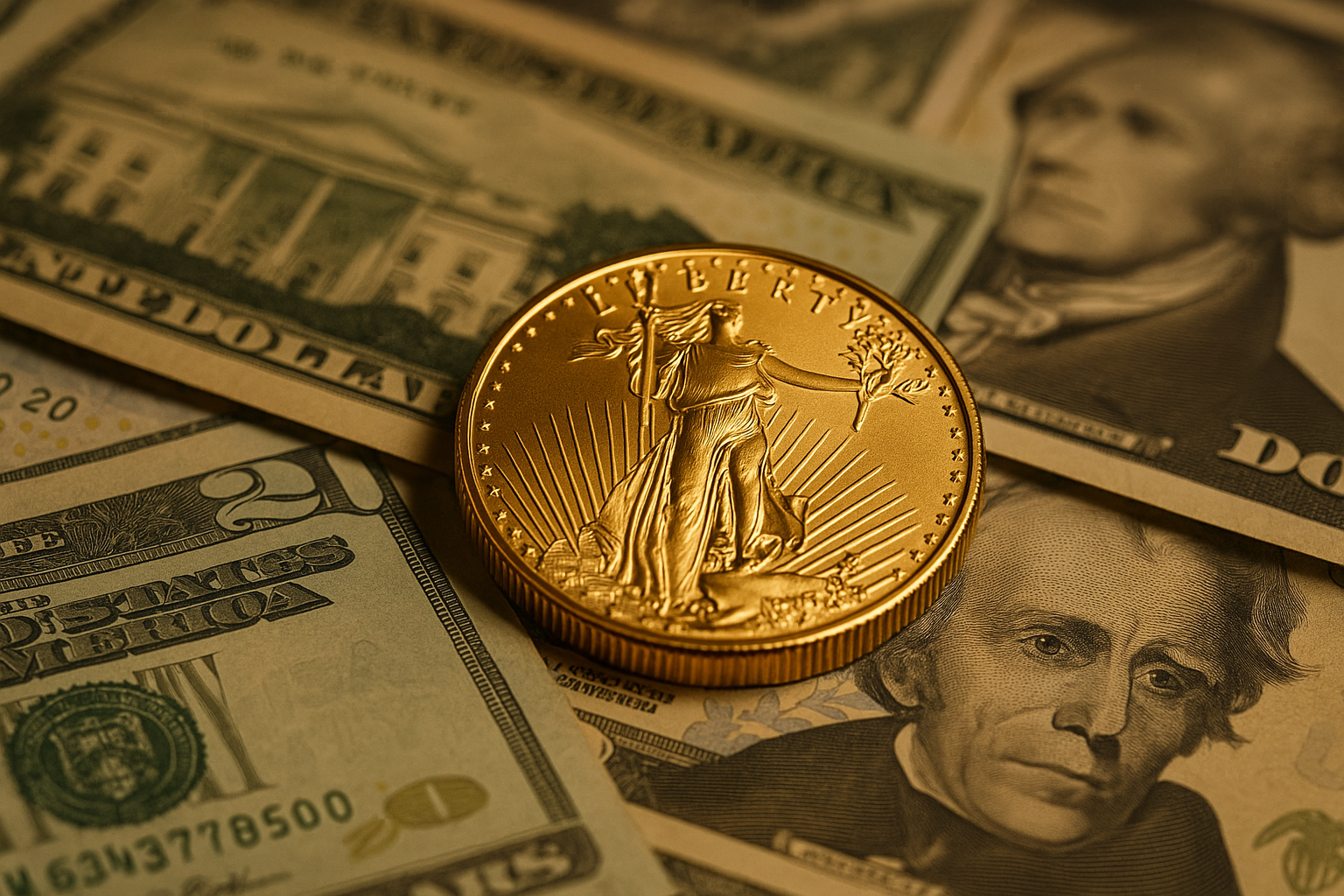
For most of the twentieth century, gold was not an investment. It was a constant.
At the dawn of the 1900s, the United States dollar was defined by gold, not merely compared to it. An ounce was worth $20.67—no more, no less. The figure was law, not market sentiment. Money was anchored, predictable, and restrained by physical limits. For decades, gold barely moved, not because it lacked value, but because it was value.
That stability began to crack during the Great Depression. In 1933, as banks collapsed and unemployment soared, the federal government intervened decisively. Gold ownership was restricted, the dollar was devalued, and the official price of gold was reset to $35 an ounce. It was the first major signal that political necessity could override monetary permanence.
Still, for nearly forty years afterward, gold remained fixed. Under the Bretton Woods system, the dollar was pegged to gold, and the world’s currencies were pegged to the dollar. From World War II through the 1960s, gold sat quietly at $35 an ounce—unchanged, unquestioned, and largely invisible to the public. Stability reigned, but pressure was building beneath the surface.
In 1971, that pressure broke. The United States ended the dollar’s convertibility into gold, severing the final link between currency and metal. What followed was not gradual adjustment, but eruption. Freed from its peg, gold surged as inflation surged with it. By the end of the 1970s, amid oil shocks, geopolitical turmoil, and waning confidence in monetary discipline, gold soared past $500 an ounce. In 1980, it briefly touched $661—an unthinkable figure just a decade earlier.
Then came the correction. Aggressive interest-rate policy restored confidence in the dollar, inflation retreated, and gold fell back into obscurity. Through the 1980s and 1990s, during an era of economic expansion and technological optimism, gold drifted downward, often hovering near $300 an ounce. The dollar was strong, markets were buoyant, and gold was widely dismissed as a relic.
That dismissal did not survive the new millennium.
The collapse of the dot-com bubble, followed by years of loose monetary policy, began gold’s long ascent. The financial crisis of 2008 turned that ascent into a sprint. As banks failed and confidence evaporated, gold reclaimed its role as a refuge, rising above $1,000 an ounce for the first time. By 2011, amid sovereign debt fears and unprecedented monetary intervention, it reached new highs near $1,800.
The following decade brought pauses and pullbacks, but the direction was unmistakable. Each crisis reinforced gold’s appeal not as a speculative asset, but as a measure of doubt—doubt in fiscal restraint, in monetary permanence, and in the durability of paper promises.
That doubt crystallized during the COVID-19 pandemic. Trillions in stimulus, near-zero interest rates, and resurging inflation sent gold past $2,000 an ounce in 2020. In the years that followed, as global uncertainty deepened and confidence in currencies wavered, gold climbed further still, reaching fresh nominal records.
The story gold tells is not merely one of price, but of trust. When the dollar was anchored, gold was silent. When discipline faltered, gold spoke loudly. Its rise does not indict the dollar outright—but it does reflect the cost of abandoning limits.
Across more than a century, gold has served as a mirror. What it reflects is not greed or fear alone, but a recurring question at the heart of modern finance: how much faith can a currency command once it is backed only by confidence?
The higher gold climbs, the more that question answers itself.
Reader Discussion
Add your perspective
Comments are open to Reader Briefing subscribers. Enter your subscriber email, request a 6-digit code, then post your comment.