
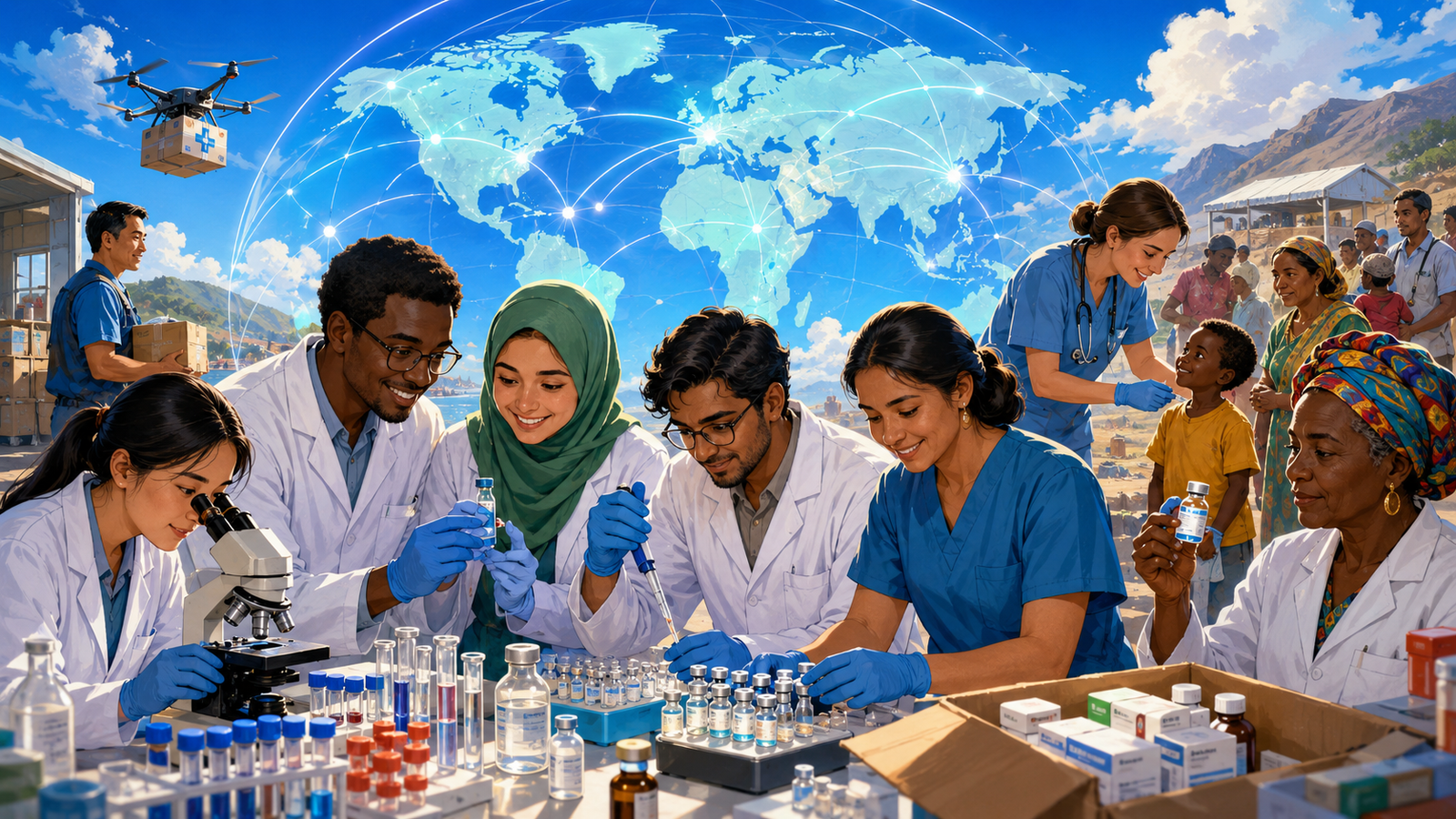
There is a future in which the place where a person is born no longer decides whether a lifesaving medicine reaches them in time.
In that future, a child with a treatable disease is not denied survival because a medication is priced beyond a family’s income or unavailable in the country where the child lives. A public-health emergency does not become a contest in which wealthy nations purchase safety first while poorer nations wait for leftovers. A patient does not learn that a therapy exists, works and remains unreachable because the legal right to profit from it stands above the human need to live.
For generations, medical science expanded the boundaries of survival.
Researchers discovered vaccines, antibiotics, antiviral drugs, cancer therapies, insulin, diagnostics and treatments that allowed people to live through conditions once considered hopeless. Public universities, government grants, clinical-trial participants, scientists and private companies all contributed to achievements capable of lifting suffering from millions of lives.
Yet discovery and access were too often separated.
Medicine could exist and still not arrive.
A cure could be possible and still unaffordable.
A vaccine could be produced and still distributed according to purchasing power rather than human need.
No one should deny that innovation requires investment or that companies performing difficult scientific work deserve fair reward.
But medicine is not an ordinary product.
When access determines whether someone lives, the moral purpose of discovery cannot end at the patent office.
Research Funded With Public Responsibility
Much of modern medicine is made possible not by one company acting alone, but by a chain of public and private contributions.
Taxpayers fund foundational science. Universities conduct research. Patients accept risks in clinical trials. Governments purchase large quantities of medicines. Public systems treat the people whose health depends on those discoveries.
A future built around human survival would attach public obligations to publicly supported innovation.
When a government finances research, guarantees purchases or helps de-risk development, agreements could require affordable pricing, transparent costs, fair licensing and access for low-income communities and countries. Public investment should not create private monopolies able to charge the public whatever desperation allows.
Pharmaceutical companies could still earn revenue and support continued research. But prices for essential medicine should be connected to fair returns, not the maximum amount a sick person, an insurer or a national health system can be forced to pay.
A medicine built partly through public sacrifice should carry a public promise.
No family should finance the same discovery twice: once through taxes and again through a price that threatens their home or their life.
Factories Ready Before the Emergency
The world has repeatedly learned that the ability to invent medicine is not the same as the ability to manufacture and distribute it fairly.
During outbreaks and global health emergencies, countries with greater purchasing power can secure supplies first, leaving others vulnerable not because science failed, but because production and distribution were concentrated in too few places.
A better world would invest in regional manufacturing capacity for vaccines, diagnostics and essential medicines across Africa, Latin America, Asia, the Middle East and other underserved regions. Laboratories, trained workforces, quality controls, supply chains and technology transfer could be established before the next crisis rather than improvised after deaths accelerate.
Governments and companies holding critical knowledge could enter licensing agreements that allow qualified manufacturers to produce needed medicines safely and affordably during emergencies and for neglected diseases.
International institutions could coordinate stockpiles and distribution based on public-health risk rather than bidding power alone.
A pandemic does not respect borders.
Neither should the ability to survive one.
The Diseases the Market Forgot
Some illnesses are devastating precisely because they primarily affect people too poor to constitute a lucrative market.
Diseases concentrated in low-income regions may receive less research attention, fewer diagnostic tools and fewer treatment options not because the suffering is small, but because expected profits are smaller.
That is not a scientific limitation.
It is a moral decision disguised as market logic.
Governments, foundations, universities and pharmaceutical companies could create enduring research commitments for neglected diseases, antibiotic resistance, maternal health, rare diseases and conditions affecting impoverished communities. Prize funds, public laboratories, guaranteed purchasing and open scientific collaboration could reward discovery while ensuring access.
Researchers should not have to choose between pursuing medicine that saves the greatest number of overlooked people and securing the funding needed to continue their work.
Human need should be enough to place a disease on the world’s agenda.
The value of a life cannot be measured by the purchasing power surrounding it.
Transparency as a Form of Trust
Patients and governments are frequently asked to pay prices without knowing how those prices were determined.
A more honest medical system would require transparency regarding research support, manufacturing costs, public investment, licensing agreements, clinical results and pricing decisions for essential treatments.
Transparency would not eliminate every disagreement. Scientific development carries risk, failures and substantial expense. But public trust cannot grow where secrecy protects profits while patients are told sacrifice is unavoidable.
Companies that act responsibly should be able to show it.
Governments negotiating medicine prices should be accountable for securing fair access.
Hospitals and insurers should not hide costs from patients until treatment has already become debt.
A system built to preserve life should not depend on confusion.
The Prescription Every Human Being Could Reach
There is a future in which a scientist makes a breakthrough and the world begins planning not only how to celebrate it, but how to deliver it to everyone in need.
There is a future in which pharmaceutical companies are honored not only for inventing medicine, but for ensuring it reaches the people whose lives depend on it.
There is a future in which countries share technology during emergencies, regional factories protect entire populations and diseases affecting the poor receive attention equal to the value of the lives they endanger.
A patent may recognize invention.
It should never become a wall between a human being and survival.
Medicine is among humanity’s finest achievements because it expresses a simple promise: that suffering can be understood, and once understood, reduced.
The promise is unfinished when healing exists only for those who can afford the door.
The future of medicine should not be measured by how much value can be extracted from illness.
It should be measured by how many people are allowed to live because knowledge was finally treated as a gift humanity owed to itself.
Reader Discussion
Add your perspective
Comments are open to Reader Briefing subscribers. Enter your subscriber email, request a 6-digit code, then post your comment.