
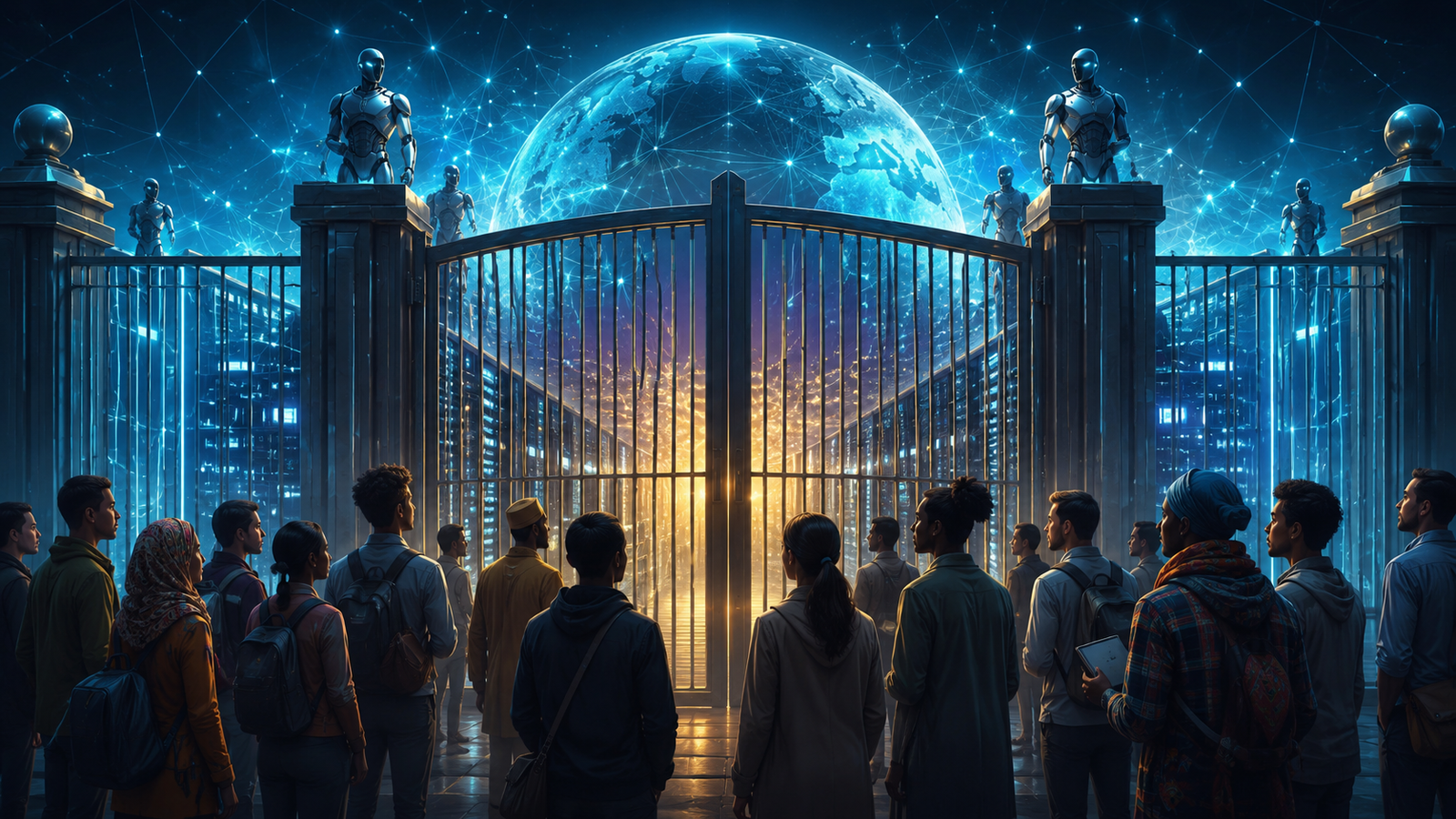
There is a future in which artificial intelligence belongs to humanity.
But this week, the world was reminded that the future may instead be rented out by a few companies and guarded by a few governments.
Al Jazeera reported that the U.S. government moved to bar foreign nationals from accessing certain top Anthropic AI models, citing national security concerns. The decision landed in the middle of a larger debate over who controls frontier artificial intelligence, who gets access to it and what happens to countries that are forced to build their future with tools they do not control.
This is not only a story about one company.
It is a story about a new kind of border.
Not a border made of fences, rivers or walls, but a border made of compute, chips, cloud contracts, export controls, model access and national-security orders.
The Digital Power Divide
Rest of World recently described the deeper problem as the great AI divide. The United States and China dominate the most advanced AI systems, computing power, investment and talent. That leaves much of the world dependent on tools built elsewhere, trained on values shaped elsewhere and governed by rules written elsewhere.
For countries in Africa, Latin America, South Asia, the Middle East and smaller European economies, the question becomes urgent: how do you build schools, hospitals, businesses, public services and research systems around AI if access can be restricted overnight?
For workers, the issue is just as serious.
If a foreign-born engineer, researcher or student can lose access to a tool because of nationality rather than conduct, then technology becomes a passport system. People who help build the machine may be told they cannot use it.
That creates mistrust.
And mistrust is dangerous in a field that already requires cooperation, safety testing, shared standards and global research.
Security Is Real. So Is Exclusion.
There are real risks.
Advanced AI systems can help write code, find vulnerabilities, accelerate cyberattacks, automate deception and assist dangerous actors. Governments have a responsibility to protect infrastructure, financial systems, public safety and national security.
But the method matters.
A broad nationality-based restriction is a blunt tool. It can punish innocent researchers, harm international collaboration, slow medicine and science, and push other countries to build competing systems with fewer shared safety rules.
A smarter approach would focus on use, risk and accountability rather than identity alone.
The world needs AI security.
It does not need digital segregation.
Solutions for a Fair AI Future
The first solution is risk-based access control.
AI restrictions should be based on behavior, use case, model capability and verified risk, not broad nationality categories. A researcher working on cancer detection should not be treated the same as a malicious actor probing cyber defenses.
The second solution is international AI safety licensing.
Countries should develop shared rules for frontier model access, including audit logs, red-team testing, incident reporting and safeguards against military or criminal misuse.
The third solution is public-interest AI infrastructure.
Governments, universities and nonprofit coalitions should build open, accountable AI tools for education, healthcare, translation, climate adaptation and small-business support. Public needs should not depend entirely on private corporate models.
The fourth solution is regional compute cooperatives.
Middle-power countries can pool data centers, chips, energy, talent and governance structures. No single country has to match Silicon Valley alone, but many countries together can create leverage.
The fifth solution is language and culture inclusion.
AI systems must be trained and evaluated beyond English and beyond wealthy countries. Languages, cultures, disability needs, local laws and community realities must be built into the systems from the beginning.
The sixth solution is labor protection.
AI adoption should come with worker retraining, job-transition support and rules against replacing people without transparency. Technology should raise human capacity, not simply cut payroll.
The Tool Must Not Become the Master
Artificial intelligence may become one of the most powerful tools in human history.
But a tool that only some people can use will widen inequality.
A tool controlled by a few governments will become leverage.
A tool controlled by a few companies will become dependency.
The question is not whether AI should be safe.
It must be safe.
The question is whether safety will be used to protect people or to control access to power.
The future should not belong only to the countries with the biggest chips, the biggest companies and the strongest export controls.
The future should belong to the people who will live inside it.
Reader Discussion
Add your perspective
Comments are open to Reader Briefing subscribers. Enter your subscriber email, request a 6-digit code, then post your comment.