
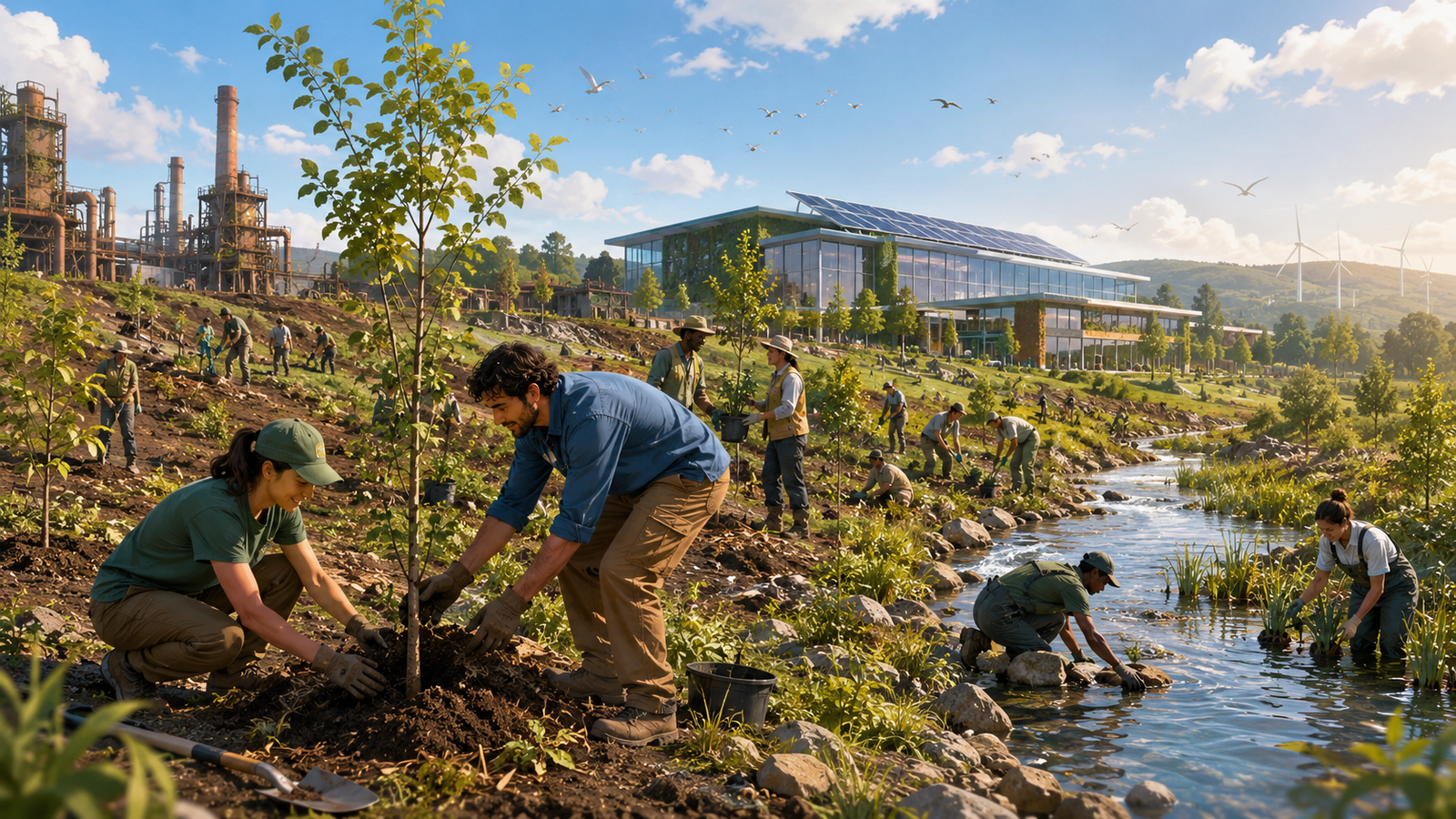
There is a future in which companies no longer describe the natural world as an externality.
In that future, a corporation that extracts minerals must restore land. A food company must protect soil and water. A fashion brand must account for waste and pollution. A technology firm must confront the energy and materials behind its devices. A manufacturer must design products that return safely into use, repair or recycling rather than becoming permanent burden.
For generations, business accounting counted revenue carefully and damage selectively.
A forest could be cut and called profit.
A river could be polluted and called disposal.
A mountain could be mined and called production.
A landfill could grow and be called the consumer’s problem.
The balance sheet looked clean because the earth carried what the ledger refused to hold.
A better future would change the accounting.
If nature makes business possible, then nature must be repaid.
From Extraction to Restoration
Every company depends on the living world.
Some depend directly on land, water, forests, minerals, crops, oceans and energy. Others depend indirectly through supply chains, buildings, packaging, transportation, data centers and the communities that support workers and customers.
No business is separate from ecology.
A restorative business model would measure what it takes and what it returns. Companies would track land disturbance, water use, carbon emissions, waste, chemical releases, biodiversity loss and community health impacts. Then they would be required to reduce harm and fund restoration.
This is not philanthropy.
It is repayment.
A mining company should not leave toxic landscapes for taxpayers.
A beverage company should not drain local water without restoring watersheds.
A real estate developer should not remove trees, increase heat and call the project progress without investing in green infrastructure.
A business that profits from the earth should help repair the earth.
Circular by Design
Waste must also be designed out of business.
For too long, companies created products meant to be sold, used briefly and discarded. Packaging became trash almost immediately. Electronics became obsolete quickly. Clothing was produced cheaply and disposed of rapidly. Appliances became difficult to repair. The planet became a warehouse for things no longer profitable.
A restorative economy would design products for durability, repair, reuse, refill, remanufacturing and recycling.
Companies could use materials that can return safely into production. Packaging could be reduced or made reusable. Repair parts could be available. Clothing could be made to last. Electronics could be modular. Construction materials could be recovered instead of buried.
Governments could require producer responsibility, meaning companies remain accountable for what happens to products at the end of their useful life.
When companies must pay for disposal, they begin designing differently.
Responsibility changes design.
Water as a Sacred Business Constraint
Water will become one of the defining business issues of the century.
Factories need it. Farms need it. Data centers need it. Communities need it. Ecosystems need it. Yet many business models still treat water as cheap until scarcity becomes crisis.
A restorative company would ask not only how much water it can legally use, but whether its use protects the watershed and the people who depend on it.
Businesses could invest in water recycling, efficient processes, watershed restoration, rainwater systems and community water infrastructure. They could avoid locating water-intensive operations in regions already under severe stress. They could disclose water risks honestly rather than hiding them in technical reports.
No company should be allowed to prosper by draining the future of the community around it.
Water is not merely an input.
It is life shared.
Business and Biodiversity
A business world that pays nature back would also protect biodiversity.
Pollinators, wetlands, forests, fisheries, grasslands, insects, birds, coral reefs and soil organisms are not decoration. They support food systems, climate stability, medicine, water filtration and human survival.
Companies could protect habitat across their operations, avoid deforestation, restore native landscapes, reduce pesticide harm and support conservation led by Indigenous peoples and local communities.
Biodiversity loss should be treated as a business risk and a moral failure.
A company cannot claim sustainability while destroying the living systems that sustainability requires.
Communities First in Repair
Environmental restoration must not become another decision imposed from above.
Communities harmed by pollution, extraction or waste should help decide what repair looks like. This includes health monitoring, cleanup standards, land restoration, local jobs, compensation, safe housing, water protection and long-term oversight.
Indigenous nations must have authority over projects affecting their lands, waters and sacred places. Consent is not a courtesy. It is a requirement of justice.
A company that harmed a place should not control the story of its own repair.
The people who lived with the damage must help define what healing means.
Profit That Can Face the Future
There is a future in which investors reward restoration, not depletion.
There is a future in which companies compete to make durable goods, clean supply chains, restore watersheds, protect biodiversity and reduce waste before regulators force them.
There is a future in which business schools teach that profit built on ecological collapse is not success. It is delayed failure.
A company can make money and still serve life.
But it must stop pretending that damage disappears because it happens off the balance sheet.
The businesses that rebuilt what they took did not stop being ambitious.
They became ambitious in a larger way.
They chose to measure success not only by what they extracted from the world, but by what remained alive because they existed.
Reader Discussion
Add your perspective
Comments are open to Reader Briefing subscribers. Enter your subscriber email, request a 6-digit code, then post your comment.