
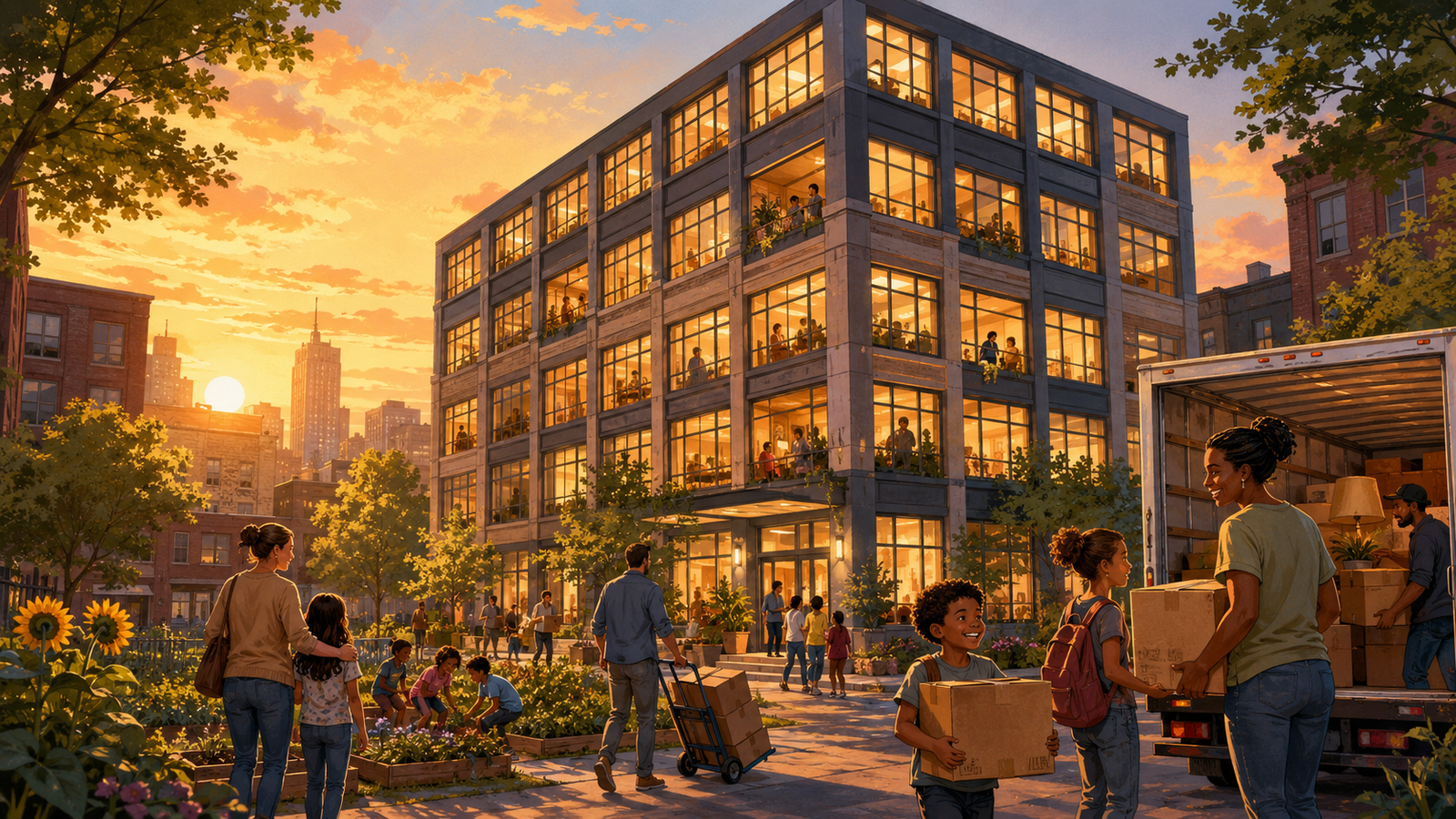
There is a future in which a person can walk through a city at night and no longer see two realities standing side by side: people sleeping beneath overpasses while office towers remain dark, vacant apartments collect dust and abandoned commercial buildings wait for their value to rise.
In that future, America finally recognizes an unbearable contradiction. A society does not suffer from a lack of shelter while usable buildings stand empty. It suffers from a failure of priorities.
For decades, housing was spoken of as a market problem alone. If rents rose beyond wages, people were told the market was responding to demand. If neighborhoods emptied of working families, displacement was described as development. If someone lost a job, became sick, fled domestic violence or aged out of foster care and ended up without a home, their emergency was too often treated as a personal failure rather than the predictable outcome of systems that offered no margin for survival.
Meanwhile, whole corridors of commercial buildings sat underused. Corporate offices built for a different era lost tenants. Hotels closed. Public properties deteriorated. Investment groups held apartments vacant while waiting for higher returns.
The question became impossible to ignore: if a country possesses the physical spaces capable of sheltering people, why are so many still left outside?
The First Door Opened
A national housing restoration effort would begin with an inventory.
Cities and states could identify vacant office buildings, unused hotels, publicly owned structures, abandoned schools, empty apartments and corporate properties held without meaningful occupancy. Not every building can become housing safely or affordably. But many can be converted, repaired or repurposed into homes when public policy stops treating vacancy as more acceptable than homelessness.
Governments could acquire long-vacant properties through purchase, land banks, tax incentives, vacancy penalties or public-private agreements. Buildings suitable for conversion could become permanent supportive housing, affordable apartments, transitional homes for families, residences for seniors or housing for young people leaving foster care.
Corporations could contribute more than public statements about community concern. Companies downsizing office footprints could donate or sell viable buildings below market value into community land trusts and nonprofit housing systems. Banks holding distressed properties could place them into affordable-housing programs rather than allowing them to decay behind locked doors.
A vacant building would no longer be treated as an invisible asset on a balance sheet while a person sleeps outside its shadow.
It would become what it was capable of becoming: a home.
Housing Before Crisis Becomes Catastrophe
The most humane housing policy is not one that responds only after people are already living on sidewalks, in shelters or inside cars. It is one that prevents that fall in the first place.
A family usually does not become homeless because of one dramatic decision. It happens through a chain: a rent increase, a medical bill, a missed shift, a broken vehicle, an eviction filing, a child missing school, a job lost because there is no stable place to sleep.
A government committed to keeping people housed could intervene early through emergency rental assistance, legal representation in eviction court, utility support, mediation with landlords and rapid rehousing for families already displaced.
Public agencies could treat eviction warnings like public-health alarms. When a community sees rising displacement, it should not wait for tents to appear before responding. It should deploy support while families are still inside their homes.
Employers also have a role. Large corporations that depend on workers in expensive cities could contribute to workforce housing funds, support down-payment assistance, offer emergency rent grants and stop treating housing instability as an employee’s private problem when wages are insufficient to meet local costs.
No worker should be expected to maintain a city they can no longer afford to live in.
A Home Without a Trap
Building housing is not enough if affordability disappears the moment a neighborhood improves.
Community land trusts, nonprofit ownership and permanently affordable housing protections could ensure that converted properties remain homes for ordinary people rather than temporary stepping stones toward another wave of displacement.
Tenants should have enforceable rights to safe conditions, predictable lease practices and protection against retaliation. Seniors should not be forced from communities where they spent their lives because their income did not rise as quickly as rent. Families should not have to choose between overcrowding and removal from the schools, neighbors and support systems their children depend upon.
A better housing future would not measure success only by construction cranes or rising property values.
It would ask: Who is still here when the neighborhood becomes desirable? Who has a key? Who has a safe bedroom? Who can remain?
Homes for People Who Need More Than Walls
Some people need more than an apartment key to regain stability.
People living with severe mental illness, addiction, chronic medical conditions, disabilities or the trauma of long-term homelessness may require supportive housing connected to healthcare, counseling, recovery services and case management.
This support should not be conditional on becoming perfect before receiving shelter. Stability is often what allows treatment to work.
For too long, society asked people to recover while sleeping outside, to keep medication safe without a door, to attend job interviews without an address and to prove readiness for housing while enduring the conditions most likely to keep them unwell.
A humane system would reverse the order.
First, safety.
Then, support.
Then, the patient and difficult work of rebuilding a life.
The Neighborhoods Built With Residents, Not Over Them
New housing policy would also return power to the people most affected by housing decisions.
Residents should help decide where affordable homes are built, how vacant properties are reused and what services a neighborhood needs. Public land should not automatically be surrendered to the highest bidder when it could support housing, parks, childcare, clinics or locally owned businesses.
Developers receiving public tax benefits should be required to create real affordability, not token units hidden inside luxury projects. Corporate landlords should face transparency requirements concerning rents, maintenance practices, eviction filings and vacant units.
Housing should no longer be a game in which profit is meticulously tracked while displacement is treated as collateral damage.
A City Where the Lights Came On Again
Imagine the transformation.
An abandoned hotel becomes apartments for veterans and elders.
An empty office building becomes homes for nurses, teachers, restaurant workers and families.
A vacant public property becomes supportive housing with a clinic and childcare center on the ground floor.
A child who once slept in a car now has a desk by a window.
A mother who once moved from shelter to shelter now plants flowers outside a door she can lock.
A senior no longer chooses between medicine and rent.
There is a future in which cities are not judged by the height of their towers, but by whether every person has a safe place to sleep beneath them.
There is a future in which governments stop managing homelessness as a permanent condition and corporations stop profiting from scarcity they have the power to ease.
There is a future in which empty buildings become full of ordinary life: dinner cooking, children laughing, elders resting, workers returning home at the end of a day.
A home is not merely shelter from rain.
It is the place from which a human being is able to begin again.
A society with the space to provide that beginning has no excuse for leaving its people outside.
Reader Discussion
Add your perspective
Comments are open to Reader Briefing subscribers. Enter your subscriber email, request a 6-digit code, then post your comment.