
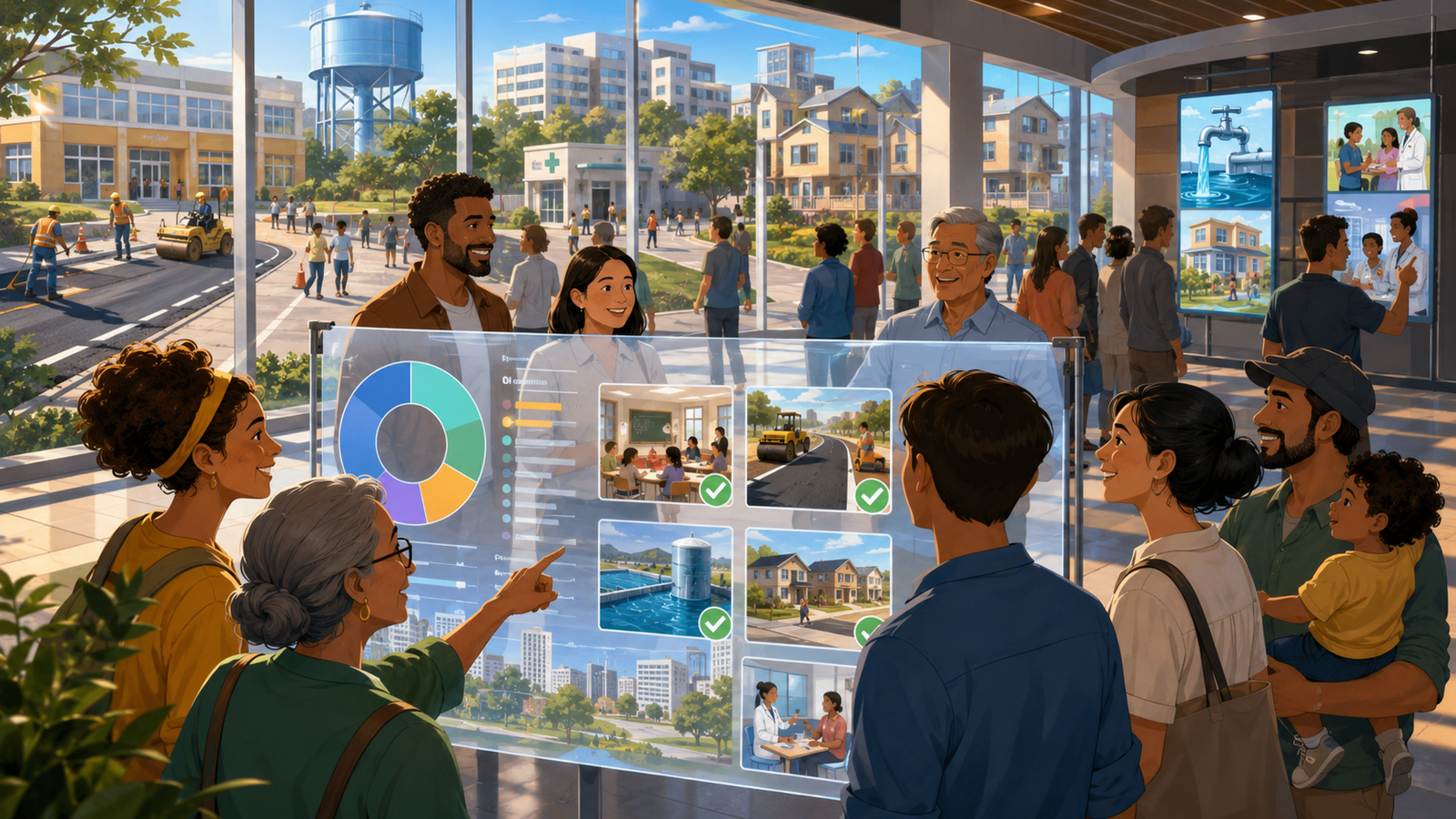
There is a future in which public spending no longer disappears into language ordinary people cannot understand.
In that future, a parent can see how much money reached the school their child attends. A small-business owner can see who won a city contract and why. A taxpayer can follow a federal grant from announcement to agency, from agency to contractor, from contractor to completed work. A community can look at a budget and know whether promises became roads, clinics, housing, water systems, teachers, food programs or nothing at all.
For generations, governments asked people to trust that public money was being used wisely.
Too often, that trust was strained.
Budgets were passed in documents too long for most citizens to read. Contracts were awarded through processes that seemed distant and closed. Projects were announced with celebration, then delayed, changed, inflated or forgotten. Money intended for communities could be absorbed by administrative layers, consultants, politically connected contractors or systems that made accountability difficult.
The public was told that government was too complicated to see clearly.
A better democracy would reject that excuse.
Public money belongs to the public.
The people should be able to follow it.
The Budget Made Visible
A transparent government would begin by making every budget understandable.
Not simplified into slogans. Not reduced to political talking points. Actually understandable.
Every city, state and federal agency could publish public dashboards showing how money is allocated, who receives it, what purpose it serves, when it is spent and what results are expected. Residents could search by neighborhood, agency, contractor, program or project.
A person should not need a law degree, accounting background or insider connection to know whether a promised bridge was funded, whether a school received its allocation or whether a housing program delivered the homes it claimed to support.
Numbers should be accompanied by plain-language explanations.
Public meetings should explain tradeoffs honestly.
Budget documents should be available in accessible formats and multiple languages.
When the public cannot understand the budget, the public cannot govern the government.
Receipts for Every Contract
Contracts are where public promises often become private profit.
A government that shows its receipts would disclose contracts, subcontractors, deadlines, change orders, cost increases, performance records and ownership connections. If a company receives public money, the public should know who owns it, what it promised, what it delivered and whether it has failed before.
This does not mean every private detail must be exposed. Legitimate privacy and security concerns exist.
But secrecy should be the exception, not the habit.
Too often, the phrase “proprietary information” has been used to shield arrangements that affect public resources. A contractor building public housing, managing public data, supplying public schools or maintaining public infrastructure is not simply a private actor. It is participating in public responsibility.
With that responsibility must come visibility.
A company that performs honest work should have nothing to fear from the public seeing the work.
The Community at the Budget Table
Transparency alone is not enough if people can only watch decisions after they have already been made.
A future worth choosing would give communities meaningful power over part of public spending. Participatory budgeting could allow residents to propose and vote on neighborhood improvements: parks, streetlights, sidewalks, school repairs, community centers, drainage, public art, safety improvements, gardens and local programs.
This would not replace elected government.
It would strengthen it by reminding public officials that residents are not spectators. They are the reason government exists.
Communities closest to harm often know where money is needed first. They know which bus stop floods, which playground is unsafe, which road lacks lighting, which building is abandoned, which seniors are isolated and which young people have nowhere to go after school.
A budget written without residents may be technically complete.
But it may still miss the truth on the ground.
Fraud Found Early, Not Years Later
A transparent government would also detect misuse quickly.
Auditors, inspectors general, journalists, watchdog groups and ordinary residents should have access to data that allows them to identify suspicious spending, repeated contract failures, conflicts of interest and projects that consume money without delivering results.
Whistleblowers must be protected. Public employees and contractors who expose waste, fraud or corruption should not lose careers for telling the truth. Strong oversight is not an attack on government. It is the maintenance required for trust.
Technology can help by flagging unusual patterns, duplicate payments, inflated costs or contractors repeatedly winning bids despite poor performance.
But technology must serve accountability, not replace judgment.
The goal is not a surveillance state.
The goal is a government honest enough to let the public inspect what is done in its name.
Trust Rebuilt Through Proof
People do not lose faith in government only because they dislike taxes.
They lose faith when they believe money vanishes.
They lose faith when officials announce programs that never seem to arrive.
They lose faith when public contracts appear to reward relationships rather than results.
They lose faith when communities are told there is no money for basic needs while waste, duplication and favoritism remain hidden.
A government that shows its receipts does not ask for blind trust.
It earns trust through proof.
It says: Here is what we collected. Here is what we spent. Here is who received it. Here is what was built. Here is what failed. Here is what we are correcting.
That kind of honesty may reveal mistakes.
But hidden mistakes grow into cynicism. Visible mistakes can be fixed.
The Day the Ledger Opened
There is a future in which public money is no longer treated as a mystery guarded by insiders.
There is a future in which every citizen can see the path between a tax dollar and a public good.
There is a future in which contractors know they will be judged by performance, officials know they will be judged by transparency and communities know they have the right to ask where the money went.
A democracy does not become weaker when people can inspect it.
It becomes weaker when they cannot.
Public money is the collected labor of millions of lives. It is hours worked, wages taxed, businesses built, purchases made and sacrifices accepted in the belief that something shared will be created.
A government worthy of that sacrifice should be willing to show its receipts.
Not as a favor.
As a duty.
Because when the public can follow the money, the money has a better chance of following the public good.
Reader Discussion
Add your perspective
Comments are open to Reader Briefing subscribers. Enter your subscriber email, request a 6-digit code, then post your comment.