
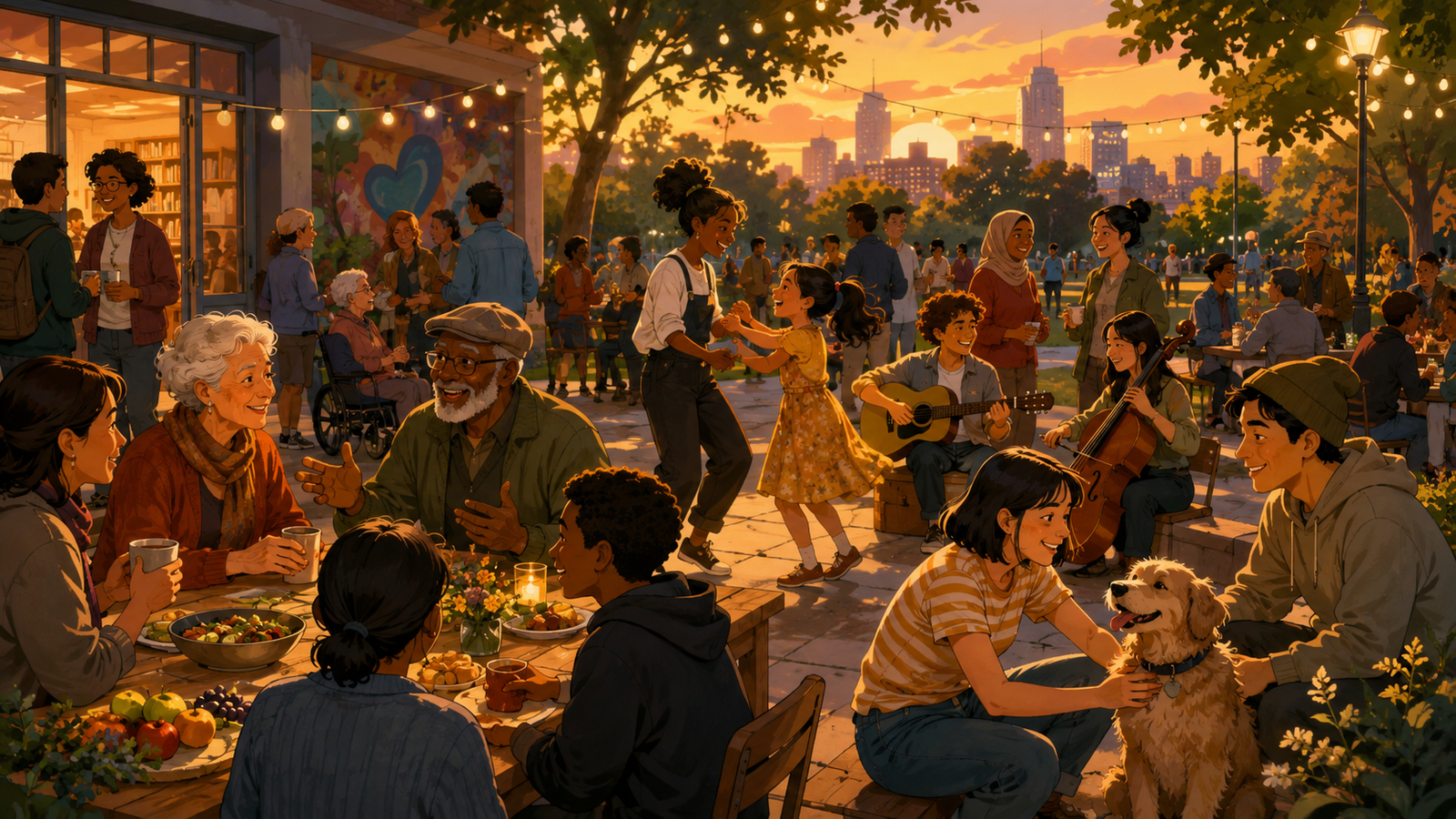
There is a future in which no one is expected to endure loneliness as though it were simply a private weakness.
In that future, an elder does not pass entire weeks without a meaningful conversation. A teenager surrounded by screens does not believe no one would notice if they disappeared. A new parent does not sit alone in a small apartment overwhelmed and unseen. A worker does not return each evening from a job filled with transactions to a life emptied of connection.
For generations, modern life became more convenient while many people became more isolated.
Neighborhood stores disappeared. Public spaces were neglected. Work became remote for some and unstable for others. Families moved farther apart under economic pressure. Seniors outlived partners and lost mobility. Young people gained constant digital contact while reporting profound loneliness. Cities filled with people who rarely learned one another’s names.
Loneliness was often treated as a sadness to be managed privately.
But isolation changes bodies, minds, families and communities. It deepens depression, weakens health, increases vulnerability and leaves people less able to withstand crisis. It allows grief to become invisible and despair to remain undiscovered.
A community is not simply a collection of people living near one another.
It is the network of attention that makes a human being feel that their presence matters.
A society that allows those networks to disappear will eventually discover that no technology, market or emergency response can fully replace them.
Places Built for People to Meet
The first response to widespread loneliness would be to rebuild the physical places where connection can happen without requiring wealth.
Libraries, parks, recreation centers, public pools, gardens, community kitchens, senior centers, playgrounds, cultural halls and neighborhood gathering spaces should be treated as essential infrastructure rather than optional amenities vulnerable to each budget cut.
A person should be able to leave home and find somewhere safe to be without being required to buy something.
Cities could design streets for walking, benches for resting, public transit for reaching one another and green spaces where children, elders and neighbors naturally share time. Vacant storefronts and unused buildings could become community rooms, arts studios, repair cafes, youth centers and places where meals are shared.
Developers receiving public support could be required to include common spaces and community facilities in major housing projects. Corporations occupying large neighborhoods could help fund public gathering places without branding them into advertisements.
Connection requires opportunity.
When every accessible space has a price tag, isolation becomes one more hardship borne most severely by people with the least.
The Elder Who Was Expected
Loneliness often becomes most severe in later life.
People retire and lose daily contact with coworkers. Partners die. Friends become ill. Adult children may live far away. Driving becomes harder. A home once filled with family becomes quiet.
A compassionate society would not treat this as an inevitable disappearance.
Local governments and community organizations could establish regular visitation programs, phone companionship networks, transportation to events and medical appointments, shared meal programs, intergenerational housing and senior centers built around purpose rather than passive care.
Older people are not merely recipients of company. They are teachers, storytellers, mentors, caregivers, volunteers and holders of memory. Schools and youth programs could connect children and teenagers with elders for reading, gardening, crafts, history, language and mentorship.
A society that isolates its elders discards knowledge while creating suffering.
A society that brings generations together gives both the old and young something they increasingly need: the feeling of being useful to someone beyond themselves.
Young People Connected Beyond the Screen
Young people can communicate constantly while still feeling alone.
Online spaces can offer friendship, creativity and belonging, particularly for those unable to find acceptance nearby. But a life shaped entirely through screens can also intensify comparison, harassment, anxiety and the feeling of watching connection rather than experiencing it.
Children and teenagers need places to gather safely in person: sports, arts, music, apprenticeships, volunteer work, clubs, outdoor programs, libraries, maker spaces and community events where friendship develops through shared purpose.
Schools could teach digital well-being without treating technology as an enemy. Parents could receive support navigating online risk. Technology companies could design platforms with greater responsibility for youth safety, mental health and harmful engagement patterns rather than allowing loneliness and outrage to become profitable sources of attention.
A young person should not have to become a brand, a performance or a crisis online in order to feel seen.
Belonging grows when someone has a role, a place to arrive and people who notice when they do not.
Work That Leaves Room for Human Beings
Loneliness is also shaped by the way people work.
Unpredictable schedules make it difficult to maintain relationships. Multiple jobs leave little time for community. Remote work can provide flexibility while also eliminating ordinary contact. Workplaces built around pressure and competition may place people beside one another without creating trust.
Employers can help rebuild connection by offering predictable schedules, paid leave, humane workloads, mentorship, employee groups, volunteer time and opportunities for workers to participate in community life.
But workplace connection must not become another demand placed upon employees. People need time and stability to build lives outside of work, with families, neighbors, faith communities, friends and civic organizations.
A worker should not be too exhausted to know the people living next door.
Economic policy is also social policy. When rent forces repeated moves, when wages require multiple jobs and when caregiving receives no support, relationships break under conditions people did not freely choose.
A connected society must make it possible for people to remain somewhere long enough to belong.
Care That Notices Isolation
Healthcare systems should also recognize loneliness before it becomes medical crisis.
Doctors, nurses and community health workers could screen for isolation among elders, new parents, people with disabilities, grieving families and patients experiencing depression or chronic illness. Referrals could connect people not only to therapy, but to social groups, transportation, peer support, community meals, exercise programs and volunteer opportunities.
Governments could fund community connection programs with the seriousness given to other public-health interventions.
No prescription can replace human companionship.
But a healthcare system can notice when someone is disappearing from contact and help reopen a door.
The Neighbor Who Knocked
There is a future in which loneliness is no longer considered the unavoidable background noise of modern life.
There is a future in which parks fill again, community centers remain open, elders are expected at the table, young people discover belonging through purpose and neighbors have reasons to learn one another’s names.
There is a future in which corporations understand that people are not merely workers or consumers, and governments understand that infrastructure includes the places and programs through which lives become connected.
No person should have to become gravely ill, desperately depressed or visibly in crisis before anyone asks whether they are alone.
Human beings are built not only to survive, but to be known.
A society may construct towers, networks, markets and machines of extraordinary complexity.
But its deepest achievement will always be simpler:
creating a world in which someone notices when another person is missing, and someone comes looking.
Reader Discussion
Add your perspective
Comments are open to Reader Briefing subscribers. Enter your subscriber email, request a 6-digit code, then post your comment.