
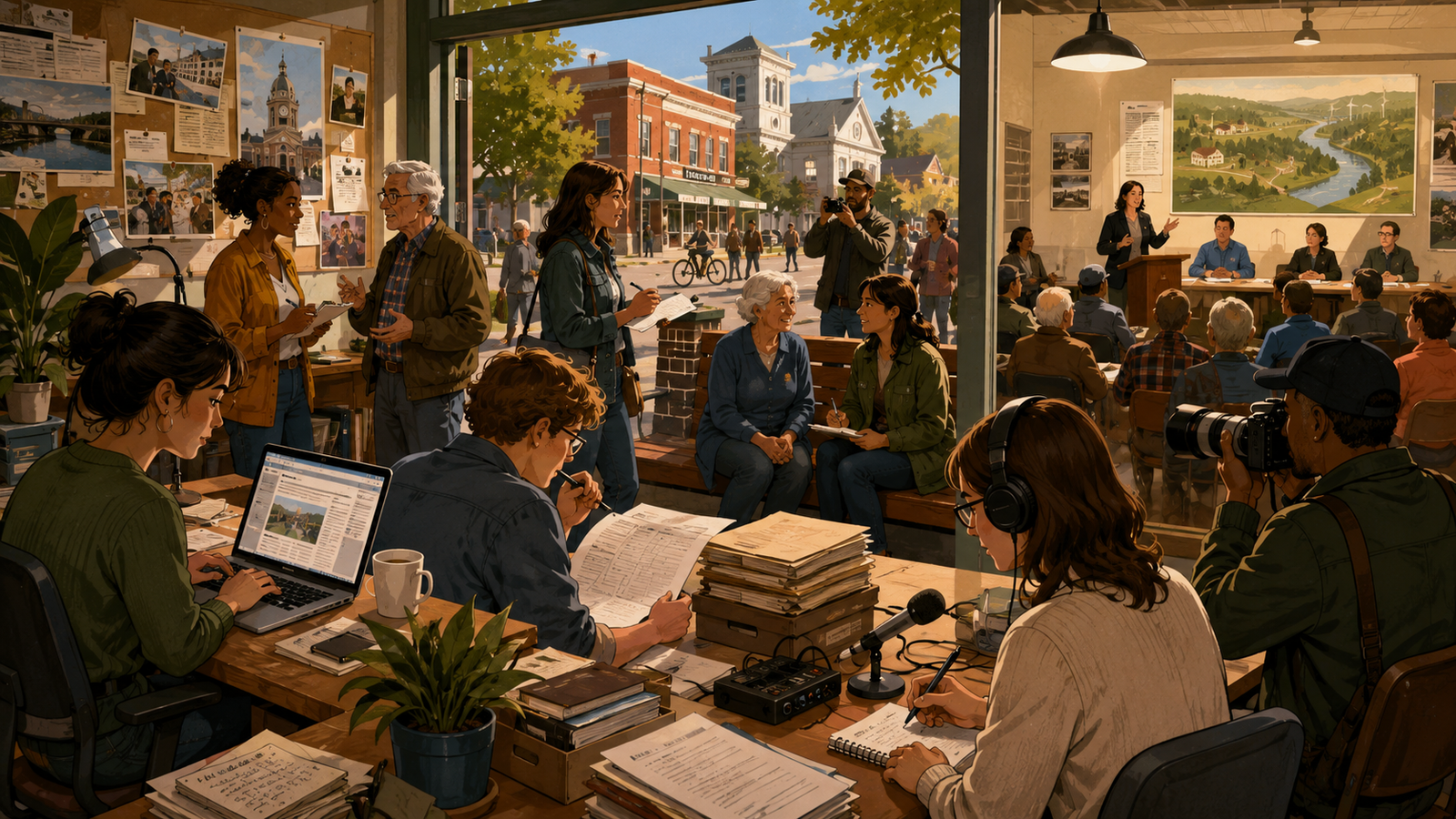
There is a future in which no town has to learn what its government is doing only after the damage is done.
In that future, school boards are covered. County budgets are examined. Courtrooms are watched. Public contracts are reviewed. Environmental risks are investigated. Corruption has reason to fear daylight. Ordinary residents can find reliable information about the place where they live without relying on rumor, outrage or social media fragments.
For generations, journalism served as one of democracy’s essential forms of public sight.
Then local newsrooms collapsed.
Advertising revenue moved to technology platforms. Newspapers closed. Reporters were laid off. Hedge funds bought local outlets and stripped them for parts. Communities became news deserts, places where public power operated with fewer witnesses and citizens had fewer shared facts.
The loss was not merely professional.
It was civic.
When journalism disappears, meetings go uncovered, officials face less scrutiny, misinformation spreads more easily and communities lose the common record required for self-government.
A better future would recognize journalism as public infrastructure.
Not government propaganda.
Not state-controlled media.
Not charity.
Infrastructure.
The public system that helps a free people see itself.
Funding Without Control
The central challenge is clear: journalism needs public support without becoming controlled by government.
A democratic society can solve this by creating independent public media funds protected by law, governed by diverse boards and insulated from political interference. Funding could come from taxes on large digital advertising platforms, public-interest media fees, philanthropy, local matching funds or civic information trusts.
The government could help fund journalism without deciding what journalists write.
Just as courts require independence, public universities require academic freedom and libraries require intellectual protection, publicly supported journalism must be shielded from political punishment.
Funds could be distributed through transparent formulas supporting local reporting, investigative journalism, community media, rural newsrooms, nonprofit outlets, ethnic media and reporting in underserved languages.
The public interest would guide the funding.
Editorial independence would protect the work.
Local Reporters Back in the Room
The first priority would be local coverage.
A functioning community needs reporters in school board meetings, zoning hearings, courtrooms, county offices, police briefings, public-health departments and environmental hearings. These are not glamorous assignments, but they are where democracy becomes real.
Local journalism tells residents what is being built, cut, polluted, taxed, hidden, debated and decided.
Public funding could support newsroom jobs in underserved areas, especially where market forces no longer sustain reporting. Programs could place early-career journalists in local outlets, support experienced investigative reporters and help community members learn reporting skills.
Local ownership matters too.
Communities should have pathways to create nonprofit newsrooms, cooperatives and public-interest outlets owned by residents rather than distant investors.
A town should not depend on a corporate chain with no local commitment to know what is happening at city hall.
The Platform Giants Paying Back
Technology platforms transformed the economics of news.
They captured advertising revenue while relying on the reporting, links, headlines, conversations and public attention journalism helped create. Many platforms profited from the circulation of information without bearing the cost of producing verified public-interest reporting.
A fairer system would require large digital platforms to contribute to journalism sustainability.
This could happen through bargaining codes, public-interest levies, licensing agreements or taxes dedicated to independent journalism funds. The money should not simply reward the largest media brands. It should strengthen local, nonprofit and independent reporting that serves communities most at risk of information collapse.
Platforms also have responsibility to reduce algorithmic amplification of falsehoods, harassment and manipulated content without becoming private censors of legitimate journalism.
A society cannot allow the public square to be governed solely by engagement metrics.
Information systems shape democracy.
They must be accountable to it.
Media Literacy as Civic Education
Public journalism infrastructure would also include education.
People need tools to distinguish reporting from opinion, evidence from rumor, correction from conspiracy and independent journalism from public relations. Schools, libraries and community organizations could teach media literacy as part of civic life.
This is not about telling people what to think.
It is about helping them evaluate how claims are made, where information comes from, what evidence supports it and how to recognize manipulation.
A healthier information culture would encourage curiosity without cynicism and skepticism without surrendering to the belief that nothing can be known.
Democracy requires trust, but not blind trust.
It requires citizens capable of asking better questions.
Protection for Journalists and Sources
Journalism cannot serve the public if reporters are threatened, sued into silence or denied access to records.
Strong freedom-of-information laws, whistleblower protections, shield laws and anti-SLAPP protections can help ensure that powerful institutions cannot bury reporting through intimidation. Public records should be timely, affordable and searchable.
Journalists covering protests, corruption, environmental harm or corporate abuse must be protected from retaliation.
The purpose of a free press is not to make government or corporations comfortable.
It is to make the public informed.
The Day the Lights Came Back On
There is a future in which every community has someone watching the public record.
There is a future in which independent journalism is funded because democracy cannot function in darkness.
There is a future in which reporters are not forced to chase outrage for survival while the slow, necessary work of covering institutions disappears.
There is a future in which technology companies contribute to the information ecosystem they profit from, citizens learn how to evaluate claims and local newsrooms become civic anchors again.
Journalism is not perfect.
It can fail, distort, overlook and disappoint. But the answer to flawed journalism is better journalism, not the collapse of public knowledge.
A society without reliable information becomes easier to manipulate and harder to govern.
When the news became public infrastructure, communities did not surrender thought to the state.
They reclaimed the ability to know what was being done in their name.
And that knowledge became the beginning of accountability.
Reader Discussion
Add your perspective
Comments are open to Reader Briefing subscribers. Enter your subscriber email, request a 6-digit code, then post your comment.