
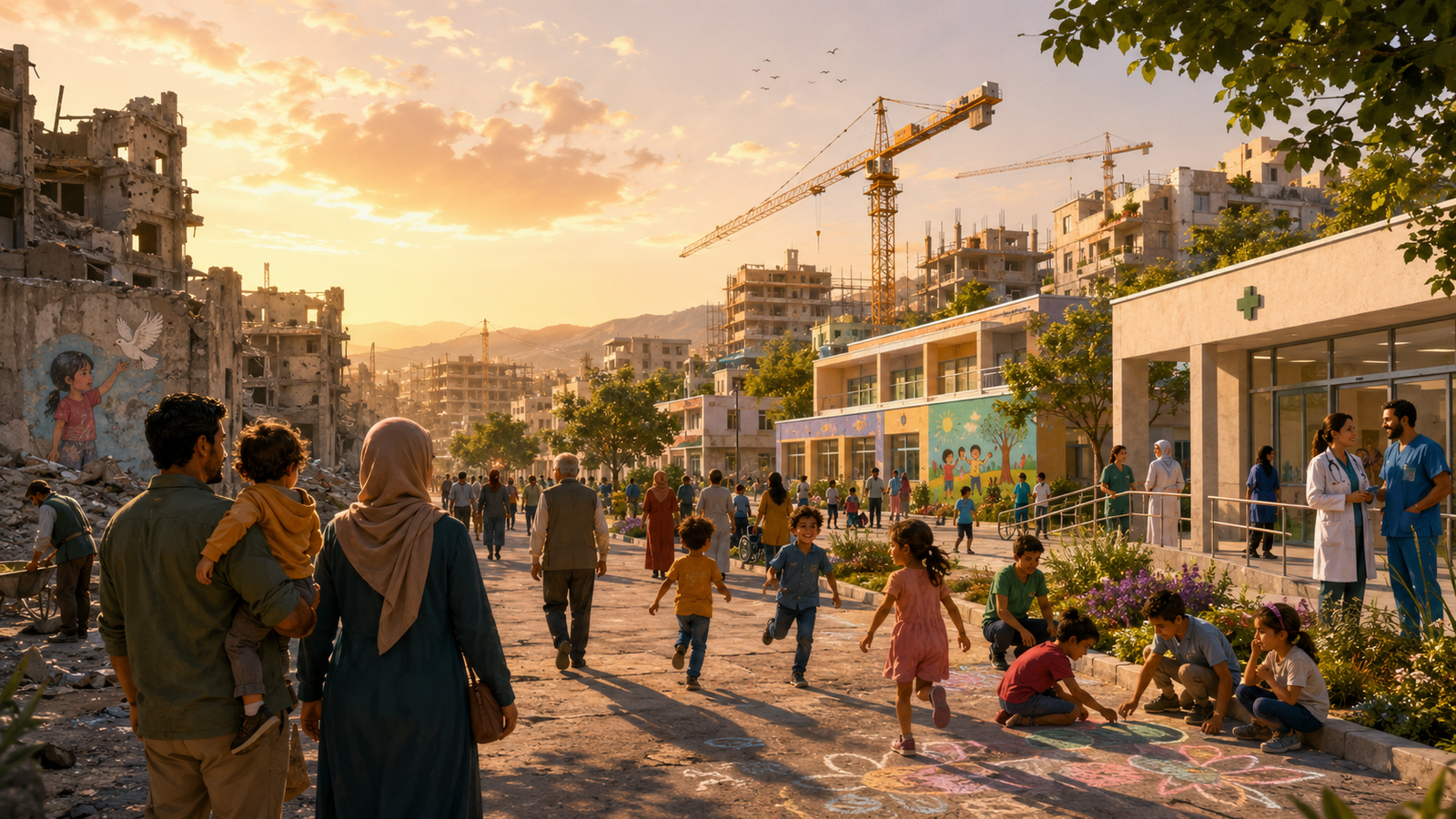
There is a future in which the end of war does not mark the beginning of abandonment.
In that future, the world does not send cameras to ruins for a week and then leave survivors to rebuild with grief, dust and promises. A destroyed hospital is rebuilt. A school reopens. Water flows again. Mines are cleared. Families return safely. Former fighters lay down weapons and find work. Children learn in classrooms instead of rubble.
For generations, wars ended on paper before they ended in people’s lives.
A ceasefire might stop the shooting, but it did not restore a limb, rebuild a home, remove unexploded shells, heal trauma, revive a farm, reopen a clinic or return a missing parent.
Reconstruction was often treated as charity after the fact.
But rebuilding is not charity.
It is the only way peace becomes real.
A peace agreement without reconstruction is a pause.
A rebuilt society is the beginning of stability.
Rebuilding the Essentials First
The first peace dividend must go to the basics of life.
Water systems, electricity, hospitals, schools, roads, sanitation, housing and food distribution should be rebuilt with urgency. These are not secondary projects. They are the conditions that allow displaced families to return, children to recover and communities to believe the war is truly over.
International funds could be released quickly after conflict ends, with strong oversight to prevent corruption. Local workers should be hired wherever possible so reconstruction provides income as well as infrastructure. Engineers, doctors, teachers, farmers and builders from the affected country should help lead the work.
Rebuilding should not become a foreign contract bonanza where companies profit while local communities remain unemployed.
The people who survived destruction should be paid to build what comes next.
Homes, Not Camps Forever
Displacement often lasts long after violence decreases.
Families may spend years in camps, temporary shelters or overcrowded homes because their towns are unsafe, occupied, destroyed or economically dead. Children can grow up knowing only emergency housing.
A peace-centered world would make safe return and dignified resettlement a core part of reconstruction.
This means clearing mines, documenting property rights, resolving disputes fairly, rebuilding housing, protecting minorities from revenge attacks and supporting those who cannot return with permanent alternatives.
A tent may save a life in an emergency.
It should not become a childhood.
Housing is where peace becomes intimate. It is the door that closes at night, the kitchen where families gather, the room where a child sleeps without listening for explosions.
A country is not rebuilt until people can live in it safely.
Healing the Invisible Wounds
War destroys more than buildings.
It changes nervous systems. It leaves grief in bodies. It teaches children fear before language. It leaves survivors with memories that do not end when the guns stop.
Reconstruction must include mental-health care, trauma counseling, community healing, support for survivors of sexual violence, care for disabled veterans and civilians, and spaces where people can mourn publicly.
Too often, trauma is treated as private suffering in countries where nearly everyone has been touched by loss.
A humane peace would make healing visible and funded.
Teachers should be trained to support children who have lived through war. Clinics should include mental-health services. Religious leaders, elders, counselors, artists and community groups should be part of recovery. Memorials should honor the dead without becoming tools for renewed hatred.
Peace requires memory.
But memory must be held in a way that does not force another generation to keep fighting the last war.
Work for Those Who Might Otherwise Return to Violence
Peace becomes fragile when people cannot survive after war.
Former fighters, displaced youth, widows, veterans, farmers, laborers and unemployed workers need real economic pathways. Without them, armed groups, criminal networks or political extremists may offer the only income available.
A peace dividend would fund jobs: rebuilding roads, restoring farms, repairing schools, clearing debris, installing renewable energy, rebuilding clinics, replanting forests, modernizing water systems and supporting small businesses.
Disarmament programs must be paired with livelihoods. A weapon surrendered should be replaced by a future credible enough to hold.
Corporations participating in reconstruction should be required to hire locally, train workers, avoid exploitation and support long-term development rather than extracting quick profits from disaster.
A stable peace is built by people who can afford not to return to war.
Justice Without Revenge
Rebuilding also requires accountability.
War crimes, corruption, atrocities and abuses cannot simply be buried beneath the need to move on. Victims deserve truth. Communities deserve justice. But justice must be designed carefully so it does not become collective punishment or revenge disguised as law.
Courts, truth commissions, reparations, local reconciliation processes and international investigations may all have roles. The goal is not to imprison entire societies in the past. It is to establish enough truth and accountability that peace does not rest on denial.
A nation cannot rebuild on a foundation of unanswered graves.
But it also cannot rebuild if every citizen is forced to inherit guilt forever.
Justice must protect the future by naming the past clearly.
The World That Stayed
The deepest failure after many conflicts is that the world leaves too soon.
Attention moves. Donors shift priorities. Promises shrink. Survivors are thanked for their resilience while being left to carry burdens no one should have to carry alone.
A better international system would commit to long-term rebuilding partnerships measured in decades, not news cycles. Funding should support local governance, anti-corruption safeguards, women’s leadership, education, healthcare, agriculture, energy and civic institutions.
Peace is not a ribbon-cutting ceremony.
It is maintenance.
It is patience.
It is the daily reconstruction of trust.
The Day Peace Became Visible
There is a future in which the end of war is followed not by neglect, but by a great turning toward life.
There is a future in which cranes rebuild homes, teachers reopen classrooms, doctors return to clinics, children play where rubble once stood and former fighters become builders of the country they once nearly lost.
There is a future in which nations spend less preparing for the next destruction and more repairing the last one.
The peace dividend is not simply money saved from war.
It is imagination released from war.
It is what becomes possible when a society decides that survival is not enough, that ruins are not destiny and that people who endured violence deserve more than condolences.
The true measure of victory is not who stands over the battlefield.
It is whether children can one day walk across it without knowing where the graves were.
When nations invested in rebuilding instead of destruction, peace finally became something people could touch.
A roof.
A school.
A clinic.
A road home.
Reader Discussion
Add your perspective
Comments are open to Reader Briefing subscribers. Enter your subscriber email, request a 6-digit code, then post your comment.