
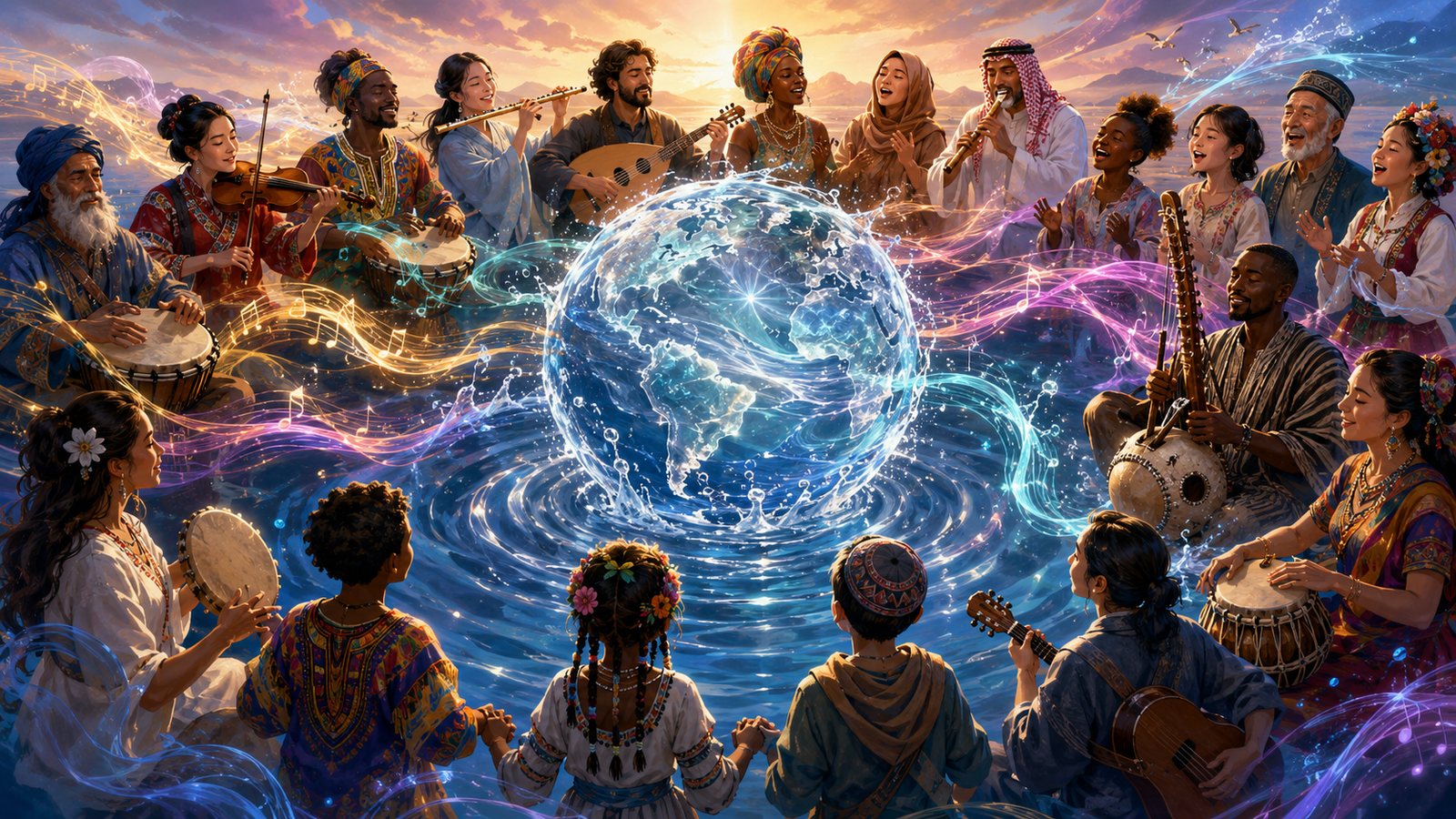
Before nations spoke the same language, they understood rhythm.
Before people agreed on politics, religion, borders or history, they could still gather around a drum, a voice, a melody, a chant, a horn, a choir, a song.
Music has always carried something that ordinary speech cannot always reach. It moves through the body before it asks permission from the mind. It enters rooms where arguments have failed. It can make strangers clap together, mourn together, dance together, pray together and remember together.
That is the power of music.
It does not erase difference.
It gives difference a place to belong.
Across the world, every people has music. Every nation has sound. Every culture has rhythm. The instruments may change. The language may change. The tempo may change. The style may change. But the human response remains familiar.
A mother hums to a child.
A village gathers around drums.
A church choir lifts a room.
A protest song gives courage to the oppressed.
A national anthem binds a people to memory.
A street musician stops strangers in their tracks.
A peace concert brings together those who may never agree on everything, but can still stand under one sky and feel one shared vibration.
Music becomes a bridge because it does not require people to become identical. It allows them to remain themselves while still entering something together.
That is what makes it powerful.
In a divided world, people are often trained to see difference as danger. Different language. Different skin. Different flag. Different religion. Different history. Different customs. Different pain.
But music has a way of turning difference into beauty.
A drum from Africa can meet a violin from Europe. A flute from Asia can meet a guitar from Latin America. A chant from Indigenous tradition can meet a modern beat from the city. Jazz, reggae, gospel, hip-hop, classical, blues, folk, soul, spirituals, rock, country, Afrobeat, salsa and sacred music can all carry the fingerprint of a people.
When those sounds meet, they do not have to destroy one another.
They can create harmony.
That is the lesson humanity needs.
Peace is not sameness.
Peace is rhythm without domination.
Peace is many voices learning when to lead, when to listen, when to support and when to make room.
The Vehicle of Peace
Music has often appeared where pain was deepest.
Enslaved people sang spirituals to survive the cruelty of bondage. Civil rights movements used songs to strengthen courage in the face of hatred. Antiwar movements used music to question violence. Freedom struggles across Africa, the Caribbean, South America and the United States used rhythm and song to remind people that oppression could not silence the human spirit.
Music became more than entertainment.
It became memory.
It became resistance.
It became prayer.
It became medicine.
It became a way for people to say, “We are still here.”
When used as a vehicle for peace and upliftment, music can do what speeches often cannot. It can lower the emotional temperature. It can bring people into shared breath. It can let grief be expressed without violence. It can give young people a creative path away from destruction. It can honor elders, teach history and build pride without hatred.
A nation that invests in music invests in emotional infrastructure.
It gives its people a way to process pain before that pain turns into rage. It gives communities a way to gather without weapons. It gives children a language for feeling. It gives the forgotten a stage. It gives the wounded a voice.
This is why music should not be treated as a luxury.
Music is part of public health.
Music is part of education.
Music is part of peacebuilding.
Music is part of cultural survival.
Music is one of the few tools humanity has that can enter the heart without force.
Water, Sound and the Human Body
The Japanese researcher Masaru Emoto became widely known for his claims that human intention, words and music could affect the formation of water crystals. In his work, water exposed to words, prayers or music was photographed after freezing, and he argued that positive words or harmonious music produced more beautiful crystal patterns, while negative words or harsh energy produced distorted patterns.
His work became popular because it offered a poetic idea: that water may respond to vibration, intention and emotional atmosphere.
Many scientists have criticized Emoto’s methods and conclusions, arguing that his experiments were not rigorous enough to prove the claims scientifically. So his work should not be presented as settled science.
But even when treated carefully, the idea still points toward something meaningful.
Human beings are largely made of water.
The body is not separate from sound. Sound is vibration, and vibration is felt physically. A loud drum can move the chest. A soft song can slow the breath. A certain melody can bring tears. A childhood song can awaken memory. A peaceful rhythm can calm a room. A harsh sound can create tension.
Whether or not Emoto’s water crystal claims are accepted scientifically, human beings already know through experience that sound affects us.
Music can calm the nervous system.
Music can help people focus.
Music can support healing environments.
Music can help people grieve.
Music can bring energy to tired bodies.
Music can help people feel connected when they feel alone.
In that sense, music interacts with the water-filled body not only as art, but as vibration, memory and emotion.
The body listens.
The heart listens.
The cells may not need language to respond to rhythm.
Breaking the Barriers of Difference
Music breaks barriers because it reaches the part of humanity that existed before borders were drawn.
A person may not understand the words of a song, but still understand its sorrow.
A person may not know the history of a drum pattern, but still feel its power.
A person may not belong to a culture, but still respect the beauty of its sound.
Music teaches that difference does not have to become distance.
It can become curiosity.
It can become exchange.
It can become appreciation.
It can become unity without ownership.
This is important because unity is often misunderstood. Unity does not mean every nation must sound the same. It does not mean every people must give up their language, dress, food, traditions or spiritual inheritance. True unity protects uniqueness.
A choir is not powerful because every voice is identical.
It is powerful because different voices find their place.
The bass does not have to become the soprano. The drum does not have to become the flute. The singer does not have to become the dancer. Each part remains distinct, yet together they create something greater than any one part alone.
That is a model for nations.
That is a model for humanity.
A Vehicle for Upliftment
If music can be used to divide, it can also be used to heal.
It can be used to glorify violence, or it can be used to restore dignity.
It can be used to degrade people, or it can be used to remind them of their worth.
It can be used to sell emptiness, or it can be used to carry wisdom.
The choice belongs to the people who create it, fund it, promote it and listen to it.
Imagine if nations used music as a serious instrument of peace.
Imagine exchange programs where young musicians from countries in conflict created songs together.
Imagine schools where children learned the music of other cultures alongside their own.
Imagine peace festivals built not around celebrity alone, but around reconciliation, history, healing and respect.
Imagine prisons using music to rebuild emotional awareness.
Imagine hospitals using sound to reduce fear.
Imagine communities using music circles to bring elders and youth together.
Imagine governments funding cultural diplomacy with the same seriousness they fund military diplomacy.
Imagine artists choosing to lift people instead of only entertain them.
This is not fantasy.
It is a decision.
Human beings have always used sound to organize emotion. The question is whether that emotion will be used for destruction or construction.
The Song Ahead
The world does not need music because everything is peaceful.
The world needs music because it is not.
It needs music because people are lonely.
It needs music because nations are divided.
It needs music because young people need something higher than anger.
It needs music because grief needs somewhere to go.
It needs music because difference needs a language that does not begin with fear.
Music will not solve every conflict by itself. A song cannot replace justice. A concert cannot substitute for fair laws. A melody cannot undo poverty, colonial wounds, exploitation or war.
But music can open the human spirit to the work that justice requires.
It can soften the ground.
It can prepare the heart.
It can remind enemies that they are still human.
It can remind nations that beneath the flags, there is breath.
And breath has rhythm.
The power of music is not only that it sounds beautiful.
The power of music is that it proves something humanity keeps forgetting:
Many voices can exist together without destroying one another.
Many nations can bring their own sound without losing their soul.
Many people can stand in difference and still move as one.
That is not just music.
That is peace in motion.
Reader Discussion
Add your perspective
Comments are open to Reader Briefing subscribers. Enter your subscriber email, request a 6-digit code, then post your comment.