
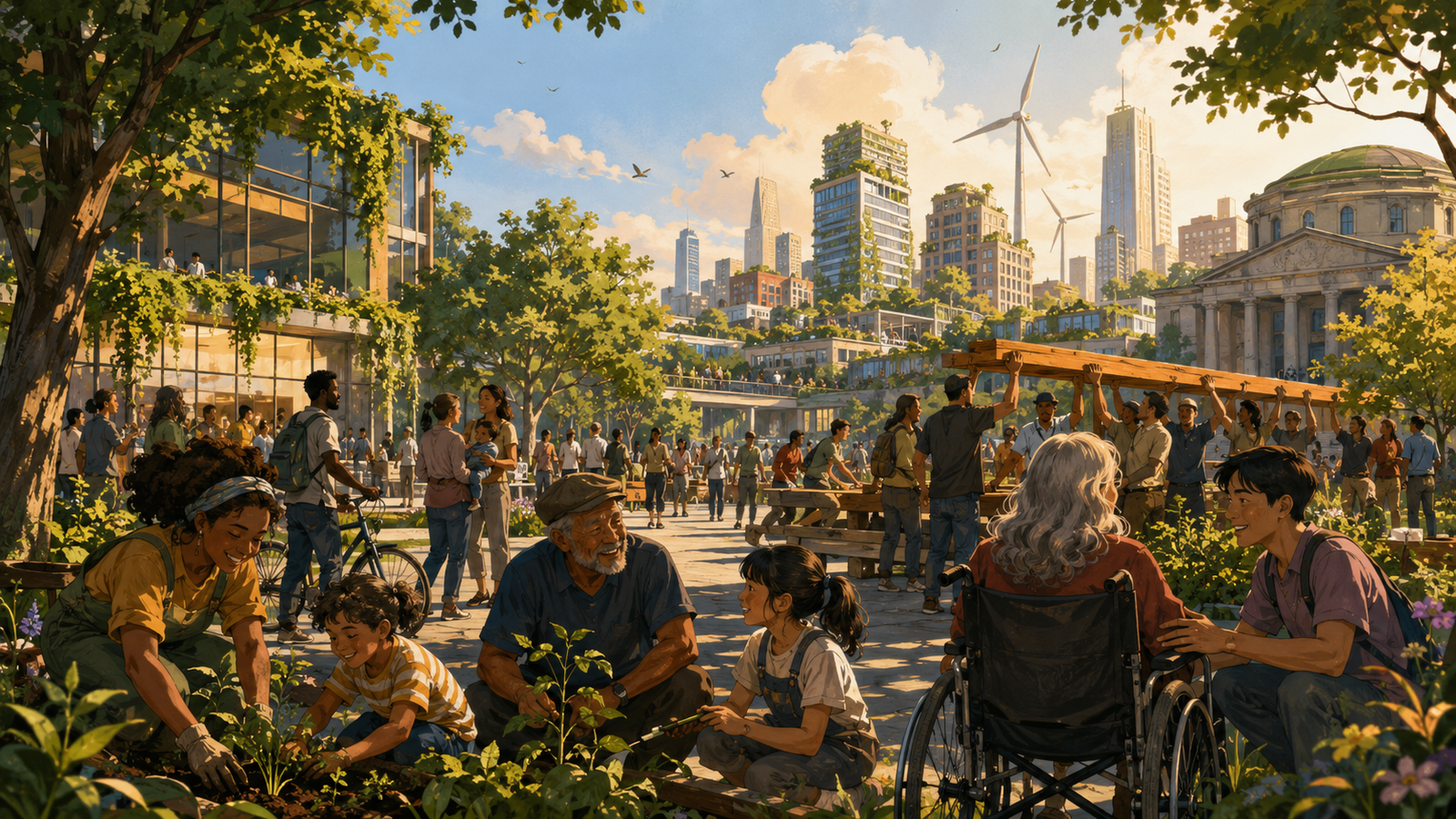
There is a future in which the first lesson a child learns about the planet is not despair.
In that future, children do not grow up believing the earth is something adults damaged and then handed to them like an unpaid debt. They do not study climate change only through graphs of loss, forests only through stories of disappearance, rivers only through warnings and wildlife only through images of what used to live nearby.
Instead, they are given shovels, seeds, soil, water, mentors and responsibility.
They plant trees.
Not as a symbolic school activity squeezed between tests.
Not as a photo opportunity for leaders who will forget the promise by the next budget cycle.
They plant trees as part of a worldwide civic mission: to restore land, cool cities, rebuild habitats, protect water, feed communities and teach every generation that healing the earth is not someone else’s assignment.
For too long, children were asked to be hopeful while watching adults postpone action.
They were told to recycle while industries polluted at scale. They were told to dream while neighborhoods overheated, forests burned, rivers dried and storms grew stronger. They were taught that the future belonged to them, but rarely given power over the systems shaping that future.
A better world would stop asking children only to worry.
It would invite them to restore.
The Classroom Moves Outside
The transformation would begin in schools.
Every school could become a restoration hub, with students learning science, history, ecology, agriculture, climate resilience and civic responsibility through direct care for living places.
Children would learn how trees clean air, hold soil, cool neighborhoods, store carbon, shelter wildlife and protect water. They would study local ecosystems, native plants, pollinators, watersheds and the history of land use in their own communities. They would learn not only what was lost, but what can still be repaired.
A schoolyard could become a small forest.
A vacant lot could become a community orchard.
A drainage ditch could become a restored wetland.
A heat-trapped playground could become a shaded refuge.
Education would no longer separate knowledge from responsibility. A student would not merely memorize the word biodiversity. They would watch it return.
Teachers would not be left to carry this work alone. Governments, universities, conservation groups, farmers, tribal nations, city planners, arborists and community elders could help build restoration curricula rooted in local land and culture.
The child who plants a tree learns something no textbook can fully teach:
the future is alive, and it responds to care.
Cities Cooled by Young Hands
In many cities, heat falls hardest on neighborhoods that were denied trees, parks and investment.
Blocks of pavement, warehouses, highways, vacant lots and poorly insulated housing can make summer dangerous, especially for elders, children, outdoor workers and families without reliable cooling.
Youth-led restoration could change that.
Cities could map the hottest neighborhoods and fund tree planting first where shade is most urgently needed. Students, youth corps, neighborhood groups and trained professionals could work together to plant and maintain trees along streets, schools, bus stops, clinics, public housing, parks and walking routes.
The goal would not be planting for appearance.
It would be planting for survival.
A tree near a bus stop can protect a worker waiting in dangerous heat.
A tree outside a classroom can lower temperatures and improve air.
A row of trees along a sidewalk can make it possible for an elder to walk safely.
A shaded playground can return outdoor childhood to places where summer heat had made it disappear.
Corporations with large parking lots, warehouses, campuses and commercial properties could be required or incentivized to replace heat-trapping surfaces with trees, solar shade, gardens and green infrastructure. Developers could be held responsible for building neighborhoods where children do not grow up surrounded by concrete without relief.
A city that children help shade becomes a city that remembers them.
Forests Planted With Justice
The world does not need tree planting that ignores people.
Too often, environmental programs have treated land as empty when it was already home to communities, cultures, farms, grazing routes, sacred places and local economies. A just restoration movement would never repeat that mistake.
Children should learn that planting trees is not simply about putting seedlings in the ground. It is about asking which trees belong, who cares for the land, who benefits, who decides and what history must be respected.
Indigenous nations and local communities should lead restoration on their lands. Tree planting should protect native species, water systems and biodiversity rather than replacing living ecosystems with single-species plantations designed only for carbon accounting.
A forest is not a spreadsheet.
It is relationship.
It is birds, insects, fungi, roots, shade, medicine, ceremony, food, memory and responsibility.
Youth restoration programs could support tribal reforestation, community woodlands, agroforestry, mangrove recovery, urban orchards, fire-resilient landscapes and watershed repair. Children would learn that restoration is not one universal formula, but a practice shaped by place.
The right tree in the right place can heal.
The wrong tree in the wrong place can harm.
Wisdom must guide enthusiasm.
A Youth Restoration Corps
A global youth restoration movement would also create work.
Teenagers and young adults could join paid restoration corps focused on tree planting, forest maintenance, soil restoration, trail building, wetland repair, invasive species removal, seed collection, nursery work, wildfire prevention and climate resilience.
This would give young people income, skills, mentorship and purpose.
It would also answer one of the deepest emotional burdens of the climate era: the feeling of powerlessness.
A young person who helps restore a riverbank, plant a community forest or care for a neighborhood orchard does not need to pretend the crisis is small. They simply learn that their hands are not useless.
Governments could fund these programs as public service. Corporations could support them through serious investment, not branding campaigns. Universities and trade schools could connect restoration work to careers in ecology, agriculture, construction, water management, forestry, public health and urban planning.
A shovel can become a first tool of citizenship.
A seedling can become a first act of public service.
Hope can become practical.
The Trees That Must Be Protected
Planting trees is not enough if mature forests continue to fall.
Children should not be asked to plant saplings while adults permit ancient forests to be destroyed for short-term profit. A young tree matters. An old forest is irreplaceable.
A serious restoration future would protect existing forests, stop illegal deforestation, hold corporations accountable for supply chains that destroy ecosystems and defend the people who risk their lives protecting land.
Children should learn the difference between restoration and distraction.
A company cannot cut down a living forest and erase the harm by sponsoring a school tree day.
A government cannot celebrate youth planting events while weakening protections for the forests already standing.
The first rule of restoration is to stop the wound from widening.
Then healing can begin.
The Ceremony of Planting
Tree planting would also become part of civic culture.
Communities could plant trees for births, graduations, memorials, citizenship ceremonies, neighborhood anniversaries, disaster recovery and public holidays. Families could return to trees year after year, watching growth become part of memory.
A child who plants a tree at age seven may sit beneath it at seventeen.
A neighborhood that plants an orchard may one day feed children not yet born.
A city that plants shade today may save lives in summers its leaders will never see.
That is the moral beauty of restoration: it requires love for people who are not here yet.
It teaches patience in a world addicted to speed.
It teaches care in a world trained for consumption.
It teaches that not every harvest belongs to the hand that planted.
The Day Children Saw the Future Growing
There is a future in which children across the world plant trees not because adults have given up, but because adults finally chose to stand beside them.
There is a future in which schoolyards become forests, cities become cooler, watersheds become healthier, farms become more resilient and young people inherit not only a crisis, but a movement.
There is a future in which governments fund restoration as seriously as they once funded destruction.
There is a future in which corporations repair landscapes instead of merely polishing their image.
There is a future in which every child learns that citizenship is not only voting, obeying laws or reciting pledges.
Citizenship is care.
Care for land.
Care for water.
Care for neighbors.
Care for generations whose names we will never know.
The world’s children planted trees, and the act was small enough for a child’s hands but large enough to change the century.
They did not plant because the future was guaranteed.
They planted because it was still possible.
And as the roots took hold beneath them, humanity remembered that hope is not a feeling we wait for.
It is something we place in the ground, protect with our labor and leave growing for those who come next.
Reader Discussion
Add your perspective
Comments are open to Reader Briefing subscribers. Enter your subscriber email, request a 6-digit code, then post your comment.