
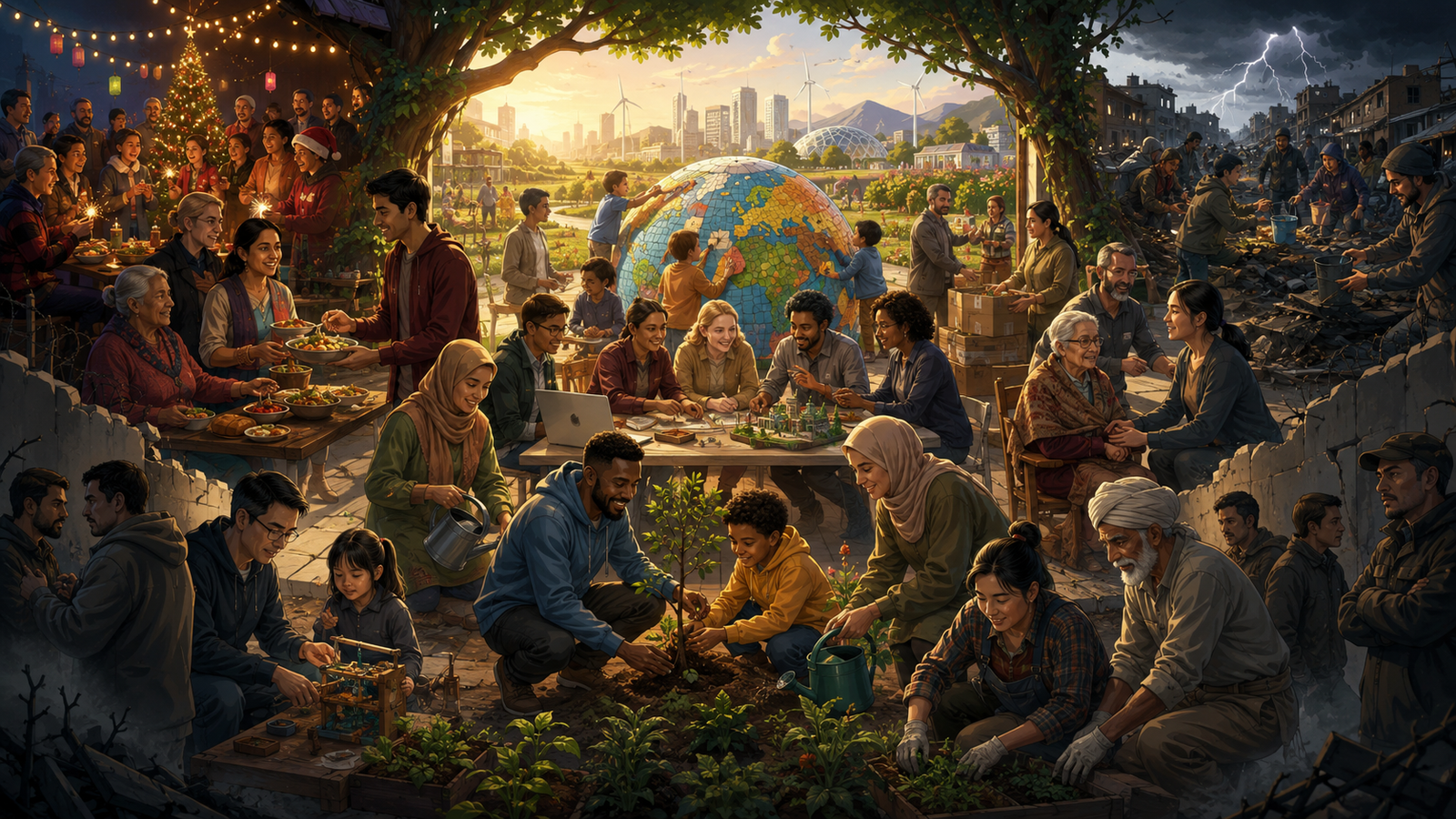
Unity is one of the most beautiful words humanity speaks.
It is also one of the least practiced.
We see it clearly on holidays. People gather around tables, songs, flags, fireworks, prayers, parades and shared memory. Families travel long distances. Communities decorate streets. Strangers smile a little easier. Nations pause long enough to remember that they belong to something larger than themselves.
We see it again during tragedy.
A storm destroys a town, and neighbors carry food across flooded streets. A fire takes a family’s home, and donations arrive from people who never met them. A school shooting shocks a nation, and candles appear in public squares. A war breaks out, and people open their homes to refugees. A pandemic spreads, and workers, nurses, teachers, drivers, farmers and volunteers become the invisible hands holding society together.
In those moments, humanity remembers itself.
The walls come down.
Political labels soften.
Race, class, religion, nationality and background do not disappear, but they become less important than the immediate question: Who needs help?
That question is powerful.
But there is a tragedy inside that beauty.
Why does unity so often require suffering before it becomes visible?
Why do people have to lose homes before communities organize?
Why do children have to die before leaders speak of healing?
Why do disasters have to strike before strangers treat one another as neighbors?
Why does humanity keep waiting for grief to remind it of what love already knows?
The Problem With Emergency Unity
Emergency unity is real, but it is incomplete.
It proves that people are capable of compassion. It proves that communities can move quickly when they care. It proves that ordinary citizens can do extraordinary things when the moment demands it.
But emergency unity often fades.
The cameras leave.
The donations slow down.
The public attention moves elsewhere.
The speeches end.
The hashtags disappear.
The people most affected are left to continue rebuilding long after the world has emotionally moved on.
That is not real unity.
That is temporary sympathy.
Real unity must be stronger than a moment.
It must be built into the way societies function before disaster arrives. It must be present in schools, neighborhoods, workplaces, governments, faith communities, businesses and families. It must show up when no one is watching, when there is no holiday, no tragedy, no public reward and no applause.
Real unity is not just standing together after something breaks.
Real unity is building systems that keep people from breaking alone.
What Real Unity Looks Like
Real unity does not mean everyone agrees.
It does not mean every culture becomes the same.
It does not mean people erase their history, beliefs, language, religion or identity.
Real unity is not sameness.
Real unity is cooperation with respect.
It means people can be different without becoming enemies. It means disagreement does not have to become hatred. It means communities can debate solutions without denying one another’s humanity. It means nations can protect their own people without devaluing other people’s lives.
Real unity looks like neighbors knowing each other before the storm.
It looks like schools teaching children how to resolve conflict, not only how to pass tests.
It looks like local governments listening to residents before neighborhoods collapse under neglect.
It looks like businesses seeing workers as human beings, not disposable tools.
It looks like wealth being used to strengthen communities, not separate the wealthy from the suffering.
It looks like churches, mosques, synagogues, temples and spiritual communities serving beyond their own walls.
It looks like nations cooperating on food, water, medicine, climate, migration and peace before crisis forces them to.
Real unity is practical.
It is food banks that do not wait for headlines.
It is mental health care before breakdown.
It is affordable housing before homelessness.
It is mediation before violence.
It is disaster planning before disaster.
It is fair wages before desperation.
It is cultural respect before resentment.
It is justice before rebellion.
It is diplomacy before war.
The World We Keep Failing to Build
Humanity has the tools to cooperate better than any generation before it.
We can speak across oceans instantly.
We can send money across borders in seconds.
We can see disasters as they happen.
We can translate languages.
We can share medical knowledge.
We can grow enough food.
We can move resources.
We can organize people.
We can teach, warn, heal and rebuild faster than ever before.
Yet division still wins too often.
Technology connects the world, but people remain isolated.
Nations share markets, but not always compassion.
Governments prepare for war more seriously than peace.
Communities celebrate unity on holidays, then return to systems that leave too many people unseen.
This is not because unity is impossible.
It is because unity has not been treated as infrastructure.
Roads are infrastructure.
Hospitals are infrastructure.
Power grids are infrastructure.
But trust is also infrastructure.
Communication is infrastructure.
Community relationships are infrastructure.
Public fairness is infrastructure.
Cultural understanding is infrastructure.
When those things are weak, every crisis becomes worse. When those things are strong, communities can absorb hardship without falling apart.
A neighborhood where people know each other survives differently than one where everyone is a stranger.
A country where institutions are trusted responds differently than one where citizens assume every leader is lying.
A world where nations cooperate responds differently than one where every crisis becomes a competition for power.
Unity must be built before it is needed.
The Holiday Lesson
Holidays show us something important.
They show that shared rituals matter.
They remind people to pause, gather, remember and give thanks. They create rhythm in society. They give families and nations moments to reconnect.
But the spirit of a holiday should not be trapped inside one day.
If people can feed strangers during Thanksgiving, why can hunger be tolerated the rest of the year?
If people can honor workers on Labor Day, why should workers struggle without dignity afterward?
If people can celebrate freedom on Independence Day, why should any group remain unheard, underpaid, overpoliced or forgotten?
If people can speak of peace during religious holidays, why should hatred be accepted in politics, media and daily life?
A holiday is supposed to teach a lesson.
The lesson should continue after the decorations come down.
The Tragedy Lesson
Tragedy also teaches.
It reveals what matters.
When a flood comes, no one asks the political party of the person trapped on a roof.
When a child is missing, no one asks the income level of the search volunteer.
When a hospital is overwhelmed, no one asks whether the nurse is from the same background as the patient.
When a community is grieving, people understand that pain is human before it is political.
Tragedy strips away illusion.
It reminds people that the divisions we worship are often smaller than the needs we share.
Everyone needs safety.
Everyone needs clean water.
Everyone needs food.
Everyone needs shelter.
Everyone needs dignity.
Everyone needs someone to care when life falls apart.
If tragedy reveals that truth, wisdom would build society around it before tragedy arrives.
Unity Around the World
Real unity must move beyond neighborhoods and nations.
The problems facing humanity are no longer isolated.
Disease crosses borders.
Pollution crosses borders.
War creates refugees across borders.
Economic collapse spreads across borders.
Food shortages cross borders.
Climate disasters cross borders.
Technology affects minds across borders.
No nation can solve these problems alone.
A divided world will keep reacting late.
A united world can prepare early.
Global unity does not require one world culture or one world government. It requires shared responsibility. It requires nations to recognize that survival is connected. It requires wealthy countries to stop treating poorer countries only as sources of labor, minerals, markets or military strategy. It requires stronger countries to practice restraint. It requires smaller countries to have a real voice. It requires corporations to be accountable to communities, not just shareholders.
Real global unity would mean clean water treated as a human priority.
It would mean medical knowledge shared faster during outbreaks.
It would mean food systems designed to prevent famine.
It would mean peace negotiations funded as seriously as weapons.
It would mean protecting Indigenous knowledge, not exploiting Indigenous land.
It would mean disaster response that does not depend on how rich or famous a country is.
It would mean humanity finally admitting that no child is foreign to the future.
Community Cooperation as a Way of Life
The future of unity is local and global at the same time.
It starts with the neighborhood.
People knowing who is elderly, who is disabled, who is alone, who needs transportation, who has skills, who has tools, who can cook, who can repair, who can teach, who can mediate, who can organize.
Every community should have cooperation networks before crisis.
Local food networks.
Youth mentorship circles.
Emergency response teams.
Conflict-resolution groups.
Community gardens.
Tool-sharing programs.
Elder care systems.
Mental health support.
Cultural exchange events.
Neighborhood assemblies.
Mutual-aid funds.
Skill-building workshops.
These are not small things.
They are the foundation of peace.
People who cooperate locally are harder to divide nationally. People who know each other are harder to manipulate through fear. People who build together are less likely to destroy together.
The Human Decision
Unity is not a miracle.
It is a discipline.
It is a decision repeated until it becomes culture.
It is choosing to listen when outrage is easier.
It is choosing to repair when blame is easier.
It is choosing to share when hoarding is easier.
It is choosing to see the person beyond the label.
It is choosing to ask, “What can we build together?” instead of only asking, “Who is at fault?”
This does not mean ignoring injustice.
Real unity cannot be built on silence.
If people are being harmed, unity requires truth. If communities have been exploited, unity requires repair. If systems are unfair, unity requires change. If history has been hidden, unity requires honesty.
Unity without justice is performance.
Unity with justice becomes transformation.
The Work Before the Sirens
Humanity cannot keep waiting for sirens before it becomes compassionate.
It cannot keep waiting for funerals before it becomes serious.
It cannot keep waiting for floods, fires, wars, shootings, earthquakes and pandemics before it remembers that life is fragile and shared.
The world needs a new kind of unity.
Not holiday unity only.
Not tragedy unity only.
Not unity for speeches.
Not unity for cameras.
Not unity that disappears when the crisis leaves the headlines.
The world needs daily unity.
Built unity.
Prepared unity.
Honest unity.
Justice-centered unity.
Community-rooted unity.
Global unity.
The kind that feeds people before famine.
The kind that listens before violence.
The kind that houses people before winter.
The kind that heals before breakdown.
The kind that negotiates before war.
The kind that teaches children cooperation before they inherit division.
The kind that understands that humanity is not weak because it is different.
Humanity is weakened when it forgets how to cooperate through difference.
The next level of civilization will not be measured only by technology, wealth or military power.
It will be measured by whether people can build communities where care is normal, cooperation is expected and no one has to suffer publicly before they are finally seen.
That is what real unity looks like.
Not a moment.
A way of life.
Reader Discussion
Add your perspective
Comments are open to Reader Briefing subscribers. Enter your subscriber email, request a 6-digit code, then post your comment.