
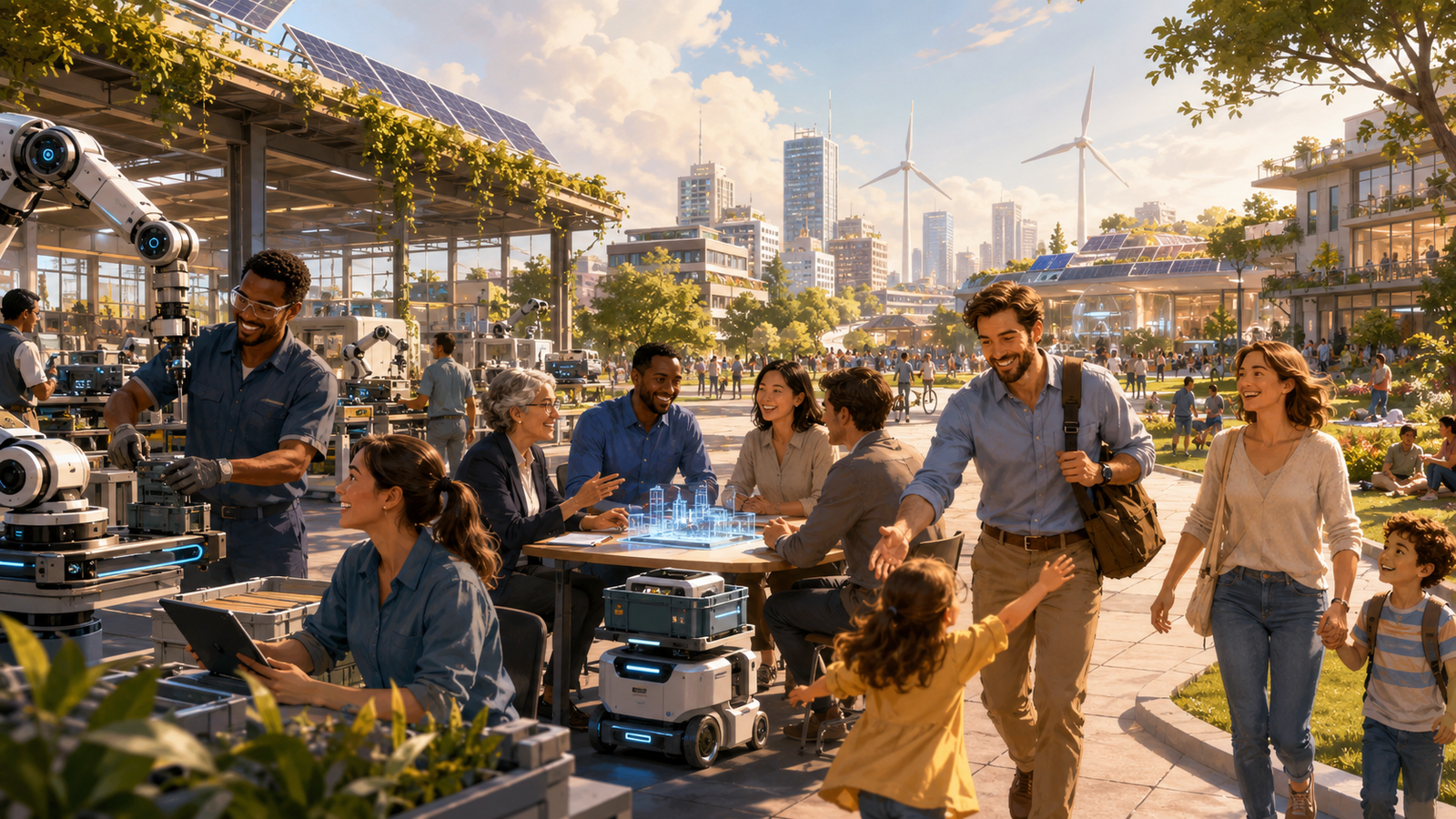
There is a future in which automation does not arrive as a threat whispered across workplaces, but as a promise shared by the people whose labor made progress possible.
In that future, artificial intelligence, robotics and advanced software increase productivity without throwing millions into insecurity. A warehouse worker is not replaced without a path forward. A call-center employee is not discarded after years of service. A nurse, teacher, mechanic, driver, designer or office worker is not told that efficiency belongs to shareholders while disruption belongs to everyone else.
For generations, new technology transformed work.
Sometimes it eliminated dangerous tasks. Sometimes it created new industries. Sometimes it increased prosperity. But too often, the people displaced by technological progress were asked to absorb the costs alone while the largest rewards moved upward.
The future of automation does not have to repeat that pattern.
Machines may perform more tasks.
But society decides who benefits.
A Fair Share of Productivity
A humane automation policy would begin with a principle: when technology produces broad economic gains, those gains must be broadly shared.
Corporations deploying AI and robotics could be required or strongly incentivized to share productivity increases through higher wages, shorter workweeks, profit-sharing, retraining funds and worker ownership plans. If a company becomes more profitable because machines and software help workers produce more, workers should not be treated as obstacles to be removed from the balance sheet.
Governments could tax extreme automation-driven profits and use the revenue to fund education, healthcare, childcare, housing, public transit and income supports. This would not punish innovation. It would ensure that innovation strengthens the society that made it possible.
Technology is built on public roads, public education, public research, public legal systems and public infrastructure.
The public has a claim on the future it helped create.
Retraining That Actually Leads Somewhere
Workers are often told not to worry because retraining will prepare them for new jobs.
Too often, that promise is vague.
A worker cannot pay rent with a slogan about lifelong learning. Retraining must be paid, practical, accessible and connected to real employment. People need time, income support, childcare, transportation and programs designed around adults with responsibilities.
Governments, unions, community colleges and employers could create transition pathways before layoffs happen. Companies adopting automation should be required to notify workers early, fund retraining and provide placement assistance. New jobs should offer decent wages, not merely a lower-paid replacement for the dignity that was lost.
Training should not be designed only for coding.
The future needs healthcare workers, electricians, caregivers, construction crews, educators, repair technicians, clean-energy workers, public servants and artists. Human work will remain essential wherever trust, care, judgment, creativity, physical presence and moral responsibility matter.
Automation should remove drudgery.
It should not remove people from the possibility of a stable life.
Shorter Work, Shared Time
One of the greatest promises of automation is time.
If technology allows society to produce more with less human labor, the reward should not only be greater output. It should be more life.
A better future could use automation to reduce working hours without reducing income. Four-day workweeks, shorter shifts, flexible schedules and more paid leave could become the dividend of productivity. Instead of using machines to demand more from fewer workers, companies could use them to give time back.
Time is not a minor benefit.
It is family dinners, rest, study, caregiving, community service, health, friendship, creativity and sleep. It is where human beings become more than instruments of production.
If automation increases efficiency but leaves people more exhausted, anxious and disposable, then the problem is not the machine.
The problem is who controls the gains.
Workers at the Table
No workplace should automate major decisions without the people affected by those decisions having a voice.
Workers understand tasks, risks, customers, patients, students, equipment and daily operations in ways executives and software vendors often do not. Their knowledge can identify where automation helps and where it harms.
Unions, worker councils and employee representatives should participate in decisions about automation, surveillance, scheduling algorithms and performance management systems. Companies should not use AI to intensify monitoring, speed up work to unsafe levels or discipline employees through opaque metrics.
Technology should assist workers.
It should not become an invisible supervisor that cannot be questioned.
A democratic workplace is one in which people are not merely informed after the future has been purchased. They help shape it before it arrives.
Public Wealth From Public Knowledge
Much of artificial intelligence grows from public knowledge: research institutions, open-source communities, data generated by millions of people, publicly funded science and cultural material created across generations.
A future built on fairness would ask whether the wealth created from collective knowledge should produce collective benefit.
Public AI models, open tools, community technology centers, small-business access and educational platforms could ensure that automation is not monopolized by a few giant firms. Antitrust enforcement could prevent a small number of corporations from controlling the infrastructure of intelligence itself.
The goal is not to stop companies from building powerful tools.
The goal is to prevent the future from being owned by so few that everyone else must rent their intelligence from them.
The Day the Machine Served the Many
There is a future in which automation lifts burdens instead of deepening fear.
There is a future in which workers share in productivity, communities receive investment, displaced people receive real support and time becomes one of the gifts technology returns to humanity.
There is a future in which AI is judged not only by what it can do, but by what kind of society it helps create.
The machine is not destiny.
The algorithm is not law.
The robot is not the author of our values.
Human beings will decide whether automation becomes another chapter in extraction or the beginning of a wider freedom.
If machines can help produce abundance, then abundance must not be locked behind the gates of ownership.
Progress is not real when only a few are carried forward.
It becomes real when the future pays the people too.
Reader Discussion
Add your perspective
Comments are open to Reader Briefing subscribers. Enter your subscriber email, request a 6-digit code, then post your comment.