
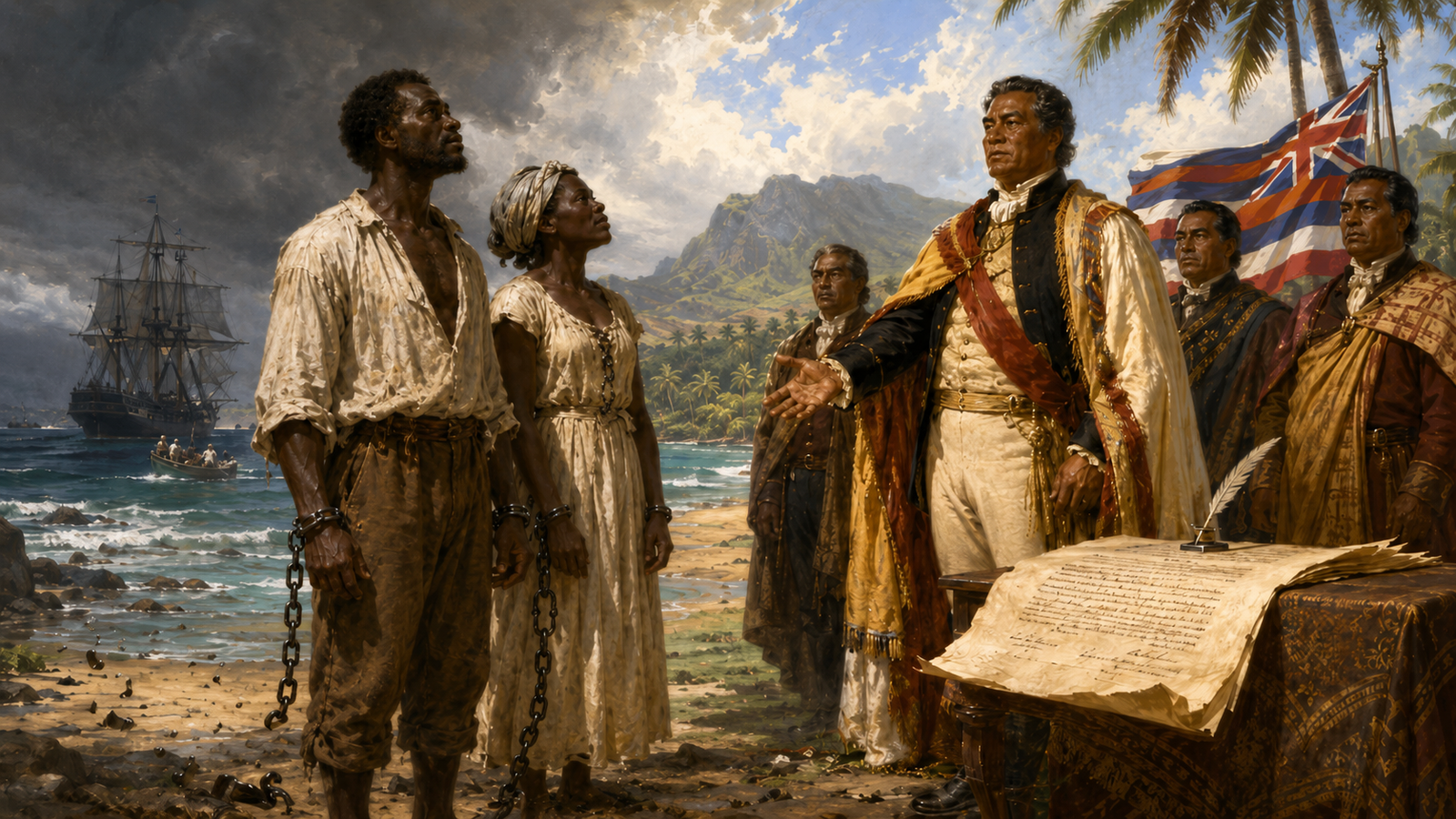
In 1852, the Hawaiian Kingdom made a declaration that carried moral, legal and political weight far beyond the islands.
Under the Constitution and Laws of His Majesty Kamehameha III, the kingdom stated that slavery would not be tolerated in the Hawaiian Islands under any circumstances. It went further. If an enslaved person entered Hawaiian territory, that person would become free. If anyone attempted to import enslaved people into the kingdom, that person would be denied civil and political rights in Hawaiʻi.
This was not a small statement.
It was a sovereign kingdom telling the world that human bondage had no legal place under its flag.
The timing mattered.
Across the Pacific, the United States was still divided by slavery. In 1852, slavery remained legal in the American South. The Fugitive Slave Act of 1850 was still in force, requiring alleged escaped enslaved people to be returned, even from free states. Black people accused under that law were denied basic protections, and citizens who helped freedom seekers could be punished.
That meant the United States was not merely tolerating slavery. It was enforcing it.
In that environment, Hawaiʻi’s position was striking. While American law protected the claims of slaveholders, Hawaiian law rejected those claims at the border. Under the Hawaiian constitution, a person brought into the islands as property would not remain property. The moment that person entered Hawaiian territory, the law recognized freedom.
That difference revealed two competing visions of law.
One vision used law to preserve ownership over human beings.
The other used law to deny that such ownership could exist.
Kamehameha III’s kingdom was not operating in isolation. Hawaiʻi sat in a dangerous world of imperial pressure. British, French and American interests all watched the islands. Foreign merchants, missionaries, naval powers and plantation interests shaped the political climate around the kingdom. Hawaiʻi had to prove that it was a modern, lawful and sovereign nation while also protecting itself from outside domination.
The anti-slavery clause must be understood in that setting.
It was not only a moral statement. It was also a declaration of jurisdiction. The Hawaiian Kingdom was saying that foreign slave systems could not be carried into Hawaiian law. A slaveholder’s claim might be recognized somewhere else, but not there. The islands would not become an extension of another nation’s bondage.
That required courage.
It required courage because the United States was powerful and expanding. It required courage because American influence in the Pacific was growing. It required courage because many nations that rejected slavery still tolerated other coercive labor systems. It required courage because the Hawaiian Kingdom, a small independent nation, was asserting a legal principle stronger than the one being enforced by one of the most powerful republics in the world.
The kingdom’s anti-slavery stance also reflected the broader constitutional language of human equality. The 1852 Constitution declared that all men were created free and equal. Its slavery clause gave that principle direct legal force.
But the history was also complicated.
The same period saw the growth of plantation agriculture in Hawaiʻi. Sugar interests expanded. Labor demand increased. Contract labor systems developed. Laws governing masters and servants created forms of labor discipline that could be harsh and coercive. Chinese contract labor began in the same year as the 1852 Constitution.
So the Hawaiian Kingdom’s anti-slavery provision should not be confused with a fully modern labor-rights system. The kingdom rejected chattel slavery, but its economy was still moving toward plantation labor structures that placed heavy pressure on workers, including Native Hawaiians and imported laborers.
That distinction matters.
The anti-slavery clause was real. It meant no person could legally be held as a slave in Hawaiian territory. It meant that the kingdom would not recognize imported slave status. It meant that freedom, not bondage, governed the legal status of enslaved people who reached Hawaiian soil.
At the same time, the kingdom’s labor laws show that freedom from slavery did not automatically mean freedom from exploitation.
That is part of the larger lesson.
A nation can reject slavery and still have to confront unfair labor. A government can declare human equality and still face economic systems that pressure the poor, the Indigenous and the immigrant. A constitution can open the door to justice, while society must still decide whether it will walk through it.
Still, in the world of 1852, Hawaiʻi’s anti-slavery language deserves attention.
At a time when the United States was moving toward civil war over slavery, the Hawaiian Kingdom had already written into law that slavery would not be tolerated. At a time when American freedom was limited by race, geography and legal status, Hawaiʻi declared that an enslaved person entering its territory became free.
That was a bold act of sovereignty.
It was also a reminder that moral leadership does not always come from the largest nations.
Sometimes it comes from a kingdom fighting to preserve its independence.
Sometimes it comes from a people who understand that law must protect humanity, not merely power.
And sometimes history leaves behind a sentence that still speaks across centuries:
Slavery shall, under no circumstances whatever, be tolerated.
Those words were not only legal language.
They were a line drawn in the sand.
They said that no foreign power, no slaveholder and no economic interest had the right to bring human bondage into the Hawaiian Kingdom.
In the shadow of an American republic still chained to slavery, Hawaiʻi chose another path.
That choice deserves to be remembered.
Reader Discussion
Add your perspective
Comments are open to Reader Briefing subscribers. Enter your subscriber email, request a 6-digit code, then post your comment.